
October 21, 2023 - PBS News Weekend full episode
10/21/2023 | 26m 45sVideo has Closed Captions
October 21, 2023 - PBS News Weekend full episode
October 21, 2023 - PBS News Weekend full episode
Problems playing video? | Closed Captioning Feedback
Problems playing video? | Closed Captioning Feedback
Major corporate funding for the PBS News Hour is provided by BDO, BNSF, Consumer Cellular, American Cruise Lines, and Raymond James. Funding for the PBS NewsHour Weekend is provided by...
Support provided by:

October 21, 2023 - PBS News Weekend full episode
10/21/2023 | 26m 45sVideo has Closed Captions
October 21, 2023 - PBS News Weekend full episode
Problems playing video? | Closed Captioning Feedback
How to Watch PBS News Hour
PBS News Hour is available to stream on pbs.org and the free PBS App, available on iPhone, Apple TV, Android TV, Android smartphones, Amazon Fire TV, Amazon Fire Tablet, Roku, Samsung Smart TV, and Vizio.
Providing Support for PBS.org
Learn Moreabout PBS online sponsorship(BREAK) LISA DESJARDINS: Tonight on PBS News Weekend, in the Middle East, Israel prepares to step up attacks on Gaza.
As the first trucks to reach the population there role in.
We speak to the United Nations aid chief about the situation on the ground and fears it could spill into larger conflict and helping Americans be safe in the water in an attempt to reverse decades of racial barriers.
WOMAN: Many communities across the South but also elsewhere unfortunately, chose to fill in destroy or close their public schools, rather than allow black Americans to swim in them.
(BREAK) LISA DESJARDINS: Good evening.
I'm Lisa Desjardins.
John Yang is away.
There are grains of relief tonight for a few of the millions who are trapped inside the Gaza Strip.
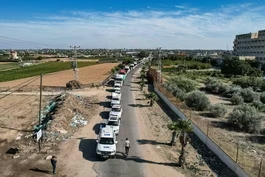
The first truckloads of supplies were allowed into Gaza from Egypt today a small but significant aid delivery after two weeks of war.
This as Israel's military is vowing to increase its airstrikes against the Hamas led territory.
The death toll continues to mount, more than 1,400 Israelis and nearly 4,400 Palestinians killed since the start of the conflict and the possibility of an Israeli ground invasion into Gaza still looms large.
Special correspondent Leila Molana-Allen has a report tonight.
LEILA MOLANA-ALLEN: At the Rafah Border Crossing a rare celebratory moment as the gates opened for the first time since the start of the war.
20 trucks full of humanitarian aid including food, water and medicine entered Gaza.
MAHMOUD ABU TATTA, Palestine Red Crescent Society (through translator): This isn't something new for us.
And we have experienced with the distribution of the supplies.
We've been through for wars before.
LEILA MOLANA-ALLEN: But humanitarian agencies say the aid is not enough.
Over 100 trucks are still stuck at the border barred from crossing.
UNICEF says the drinking water sent today is only enough for 22,000 people for one day.
Gaza's population is approximately 2 million people, with 80 percent already relying on aid before the war.
At a summit on the crisis in Egypt's capital Cairo, U.N. Secretary General Antonio Guterres said Palestinian civilians must not bear the brunt of the war.
ANTONIO GUTERRES, Secretary-General, United Nations: Nothing can justify the reprehensible assault by Hamas, that terrorized Israeli civilians, and those abhorrent attacks can never justify the collective punishment of the Palestinian people.
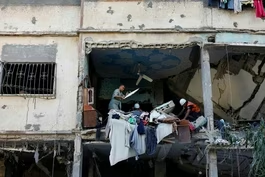
LEILA MOLANA-ALLEN: Meanwhile, the Israeli Defense Forces pummeled Gaza with fresh air strikes overnight, as they target Hamas operatives got in Gaza City an airstrike hit what residency was a family home.
WOMAN (through translator): While they were sleeping the strike hit them innocent children with their father and grandmother.
What did they do?
Did they carry weapons?
These are innocent children who know nothing tell us when this will end.
LEILA MOLANA-ALLEN: Workers at the Al Shifa Hospital in northern Gaza tried desperately to keep up with the pace of new victims.
The IDF continues to urge civilians to move south even as they strike areas there too.
REAR ADM. DANIEL HAGARI, Israeli Military Spokesperson (through translator): The humanitarian conditions in the strip are under control.
We continue to stress that the residents of the North should move to the south.
LEILA MOLANA-ALLEN: Tensions also remain high inside Israel.
The Israeli authorities have once again banned young men between 16 and 60 from entering the Al Aqsa compound for Friday prayers, a group has gathered in front of the checkpoint where they're praying as security forces turn them away.
Children collected here alongside their fathers to be as close as they could to the mosque, the third holiest site in Islam.
Suddenly armed Jerusalem Border Police arrived to push back worshipers as they knelt in the midst of prayer.
The measure is intended to prevent conflict around the contentious site.
But the faithful here say banning them is against their religious rights.
From tension in Israel to relief in the U.S., in Illinois, the family of freed Hamas hostages Natalie and Judith Raanan looked forward to their homecoming.
SIGAL ZAMIR, Raanan Family Member: This is a small joy in our family, but hopefully for all the other hostages and all the other families just keep praying and hopefully good news will come.
LEILA MOLANA-ALLEN: A rare moment of good news in a conflict with precious little of it.
For PBS News Weekend, I'm Leila Molana-Allen.
LISA DESJARDINS: In the days other headlines, the nation's deficit took a dramatic turn for the worse according to new numbers from the Treasury Department.
The gap between what the government spends and what it earns widened to $1.7 trillion in the fiscal year that ended last month, up nearly 25 percent over the previous years' numbers.
The Biden administration says the deficit effectively doubled last year when factoring out student loan forgiveness which never took effect.
On Friday, the White House asked Congress for more than $100 billion for priorities including Israel, Ukraine and the border.
And a deadly deluge hit parts of Europe for a third straight day.
At least four people are dead three in the United Kingdom from the torrential storm.
The rough weather has swamped the coasts of Germany, Denmark, Scandinavia and the U.K., with storm surge causing widespread power outages and disrupting flights, trains and ferries.
More rain is expected throughout the region on Sunday.
Still to come on PBS News Weekend, talking to kids about the war in the Middle East, and how swimming safety and historic racism are intertwined.
(BREAK) LISA DESJARDINS: The 20 trucks of humanitarian aid that crossed into Gaza from Egypt today were the first life-saving supplies to reach Gazans since the war between Hamas and Israel began, but before this month attacked by Hamas, 450 trucks of aid arrived in Gaza daily.
Earlier, I spoke to Martin Griffiths, the U.N.
Undersecretary General for Humanitarian Affairs and emergency relief about what this new aid means for the humanitarian crisis.
MARTIN GRIFFITHS, Emergency Relief Coordinator, United Nations: You know, the only thing 20 truckloads of aid can do apart from no doubt, save some lives.
And there's nothing better than saving a single life, I think, as we all know, is to show the world this can be done.
You can deliver aid to Gaza, the fact that we could get in even 20, which is very, very few tracks of aid into Gaza.
So that beleaguered tragic population means we can do it again, again, and again and again.
LISA DESJARDINS: So that leads to the next question.
I know there are scores of trucks lined up waiting to get in with more aid.
Help us understand the negotiations, the challenges, and Sure.
Is there going to be an opening for those soon?
MARTIN GRIFFITHS: Well, I really hope so I hope that I hope we'll have more deliveries tomorrow.
We're still as we speak tonight here in Cairo.
We're deep in negotiation with the different authorities about this.
We want to get in 2030 trucks tomorrow if we possibly can.
We want to go up day by day by day.
We have a target either way of getting up to 100 trucks a day.
But the issues that we have to resolve are really quite simple to understand and not easy to negotiate.
Number one, we have to agree with the Israelis in particular, but also with other parties.
What kind of inspection regime there will be to make sure that our trucks aren't going to carry aid in which is to do with a war no guns, thank you very much.
But number two, we want to be able to be sure that the humanitarian aid we deliver is delivered according to and respecting what's called the rules of war.
People should be allowed to decide where they travel, when they travel, if they travel, and where they feel safe.
So, those two things we are negotiating with all concerned.
If we can get them right and I think we will get them right and we're getting a lot of help from a lot of countries, we can start moving up that number of tracks from 20, to 30, to 40, to 50, eventually to the 100.
LISA DESJARDINS: How would you describe the humanitarian crisis right now in Gaza and where it's headed, if there isn't more aid soon?
MARTIN GRIFFITHS: One of the things that I find most terrifying about Gaza is the absolute uncertainty of what's going to happen.
People don't know, if they're going to have to move out of the north, people don't know where they're going to have to go to live in the south.
People don't know when the military operation will start.
People don't know if trucks are going to arrive.
And if they do, how long, they're going to have to wait for the next one.
Uncertainty breeds terrible insecurity, it breeds distress.
And it is a stress on life.
And it is our job as your representatives, frankly, from the international community, to try to reduce that uncertainty.
And to tell people, there will be breakfast tomorrow, where you live, it's kind of that simple.
LISA DESJARDINS: Is there a starvation risk?
I've heard some other officials say that that's real there in Gaza.
MARTIN GRIFFITHS: There will be.
There will be.
But the first risk, which is a killer, is developers, your water and the fuel that's needed to move water, you know, to make generators work, to move water so that hospitals work, clinics work, schools work and so forth.
If you don't have water, you know, as well as I do, you do not survive.
Now, UNRWA, which is this amazing U.N. organization, which knows Gaza backwards, has cut its water rations from 15 liters per person per day, down to one liter per person per day.
And when the fuel runs out, and the water runs out, you're not going to survive.
LISA DESJARDINS: Once you are able to get through negotiations once you're able to get the aid and how do you ensure that it can be secure, either from being in a target zone by Israelis or at threat from Hamas, or that workers won't be overrun by crowds?
MARTIN GRIFFITHS: Well, you know, the tragic truth of the world that you and I live in today is it's full of places that you can't be damn sure about any of those things.
First of all, we have 75 years of experience in Gaza.
We know that communities.
We believe that communities can trust us.
We want that to be maintained, so that we know where they will be safe, and we will go where they need to go.
That's the first thing.
Number two, we will insist on a diplomacy.
Your president has done an amazing job this week here in the region, in insisting on why international humanitarian law is not an optional extra, or another law to apply.
It's the bedrock, without people manage conflict humanely.
So we know.
We have law behind us.
We have diplomacy behind us.
We have the rights of people behind us, and we have the passion.
And if I may be so bold, the courage of humanitarian workers, we're not useless.
We're not without opportunities to do the job properly.
But we have a hell of a job to do here.
LISA DESJARDINS: You have a hell of a job indeed.
Martin Griffiths, the U.N. humanitarian lead, we thank you for your time and we are going to keep in very close touch.
MARTIN GRIFFITHS: Thank you so much, really appreciate it.
Have a good program.
LISA DESJARDINS: Since the war between Hamas and Israel began, news and social media have been filled with horrific images, stories of civilians killed, and hostage takings.
This information can be tough to digest for adults, but it can be especially difficult for kids news, our digital senior editor Yasmeen Alamiri looks into how and whether to talk to kids about this.
She spoke with Duke University child psychologist Robin Gurwitch.
YASMEEN ALAMIRI: Dr. Gurwitch, thank you so much for joining me.
ROBIN GURWITCH, Duke University: Thank you for having me, Yasmeen.
YASMEEN ALAMIRI: So let's start with the most basic thing.
Do we talk to our kids about the war at all?
And if so, when or how do we bring it up?
ROBIN GURWITCH: So to answer your first question, absolutely positively yes.
When we don't talk about difficult things children may not bring it up because they're worried they're going to upset you.
And all of the science tells us if adults will bring it up, they have a better chance of helping children cope with what's going on, take a deep breath in, jump in to that conversation, you can start as simply as there's a war going on in Israel and Gaza.
Tell me what you know.
YASMEEN ALAMIRI: What are the top three things that we should keep in mind or parents should keep in mind when approaching this conversation?
ROBIN GURWITCH: One would be to make sure that we as adults are in a good place to have the conversation.
We've got our emotions in check, we can have these conversations in a way that doesn't scare them or make them more anxious.
I think the second one is to answer the questions that they have, honestly, openly at a level that is at their developmental age.
And I think, thirdly, is to recognize this is not the only conversation on the topic you're going to have, this is the first and it will be important for you to circle back around in the days and months ahead.
YASMEEN ALAMIRI: As he pointed out, age is a huge component of all of this, and it makes a difference in how we approach the conversation.
So how would we speak to younger kids versus say teenagers about this?
ROBIN GURWITCH: With younger children, one of the things they're really asking about is am I safe?
And are you safe, it is okay to tell them there are many people that are hurt.
And there are some people that have died.
And we feel very sad and bad about that.
But it is equally important not to go into gruesome details, that is not important.
As children get older, they understand more nuances.
They understand that there aren't black and white answers to everything.
With teenagers sometimes we may get more by saying tell me what your friends are saying about all of this, I may share with you, my friends say.
And as caregivers, as parents, we know that they are really telling us what they're talking about with their friends and how they're thinking and what they're feeling.
YASMEEN ALAMIRI: A lot of kids are seeing this content on social media where parents have little to no control.
How do we help them deal with the unexpectedly traumatic things that they may come across in their feeds?
ROBIN GURWITCH: Check in, ask them what they're watching.
Look at it, if there are parental controls, particularly with school aged children, put those on, we know that there's quite a bit on social media right now, that is not appropriate for anyone, anybody to be watching right now, take a break from social media, turn it off, about an hour before you go to bed because sleep is often disrupted.
And if we're trying to go to sleep with images and stories of the horror that's happening right now of this sadness of the tragedy, it is going to interfere with our sleep.
YASMEEN ALAMIRI: We know unfortunately, that antisemitism and Islamophobia are on the rise in this country.
And we also know that this is playing out between children on the playground and in schools.
How do we help kids cope with being stereotyped or if they're being bullied?
ROBIN GURWITCH: I think it is important for us as adults, when we have a difficult conversation, to also help them identify.
If you ever feel like somebody is making you uncomfortable.
If they're doing or saying anything to you, please let's think about who you would tell what you would say.
I think it is also important to help them consider if you see something, what are your responsibilities?
What should you do?
And it's not necessarily that you need to intervene as much as tell somebody or to support someone.
YASMEEN ALAMIRI: How often should we be having these conversations?
When is it not enough and when is it just sometimes too much?
ROBIN GURWITCH: parents and caregivers know their children better than anyone else.
So if you are seeing that they are having a hard time with sleeping, if their behaviors are changing, maybe they are having more meltdowns or more irritability, if they're struggling with learning in school, those are usually signs that they're more anxious, more worried, more concerned, to continue to have those conversations.
When they bring it up, sit down and answer it truly don't say let's talk about it later.
Take that window.
If they ask then stop whatever you're doing and say thank you for bringing that up.
Let's sit down and talk about it.
And particularly for school age or even a little bit younger children.
Don't be surprised if they ask you the same question over and over and over again.
It's not that they're wanting different answers.
They're just is trying to process the answer that you continue to give them.
YASMEEN ALAMIRI: Dr. Gurwitch, thank you so much for joining us.
LISA DESJARDINS: For more on this good conversation on how to talk to kids about the war, visit our website pbs.org/news hour.
For many, learning how to swim is a rite of passage.
But a surprising number of American children can't swim.
Part of that comes down to access and restrictions rooted in racism that have kept generations of swimmers out of pools.
Isabella Jibilian of Rhode Island PBS explores the fight for swim safety.
RAY RICKMAN, Co-Founder, Stages of Freedom: One night phone call woman sobbing on the phone telling me that her child had drowned at five o'clock at Lincoln woods.
ISABELLA JIBILIAN: It was the early 90s and Ray Rickman was a Rhode Island State Representative.
It was that phone call from a grieving mother that sent Rickman on a new path, advocating for water safety.
RAY RICKMAN: She watched her son drown, she could not swim.
Can you imagine?
You can't imagine.
MARA GAY, New York Times Editorial Board: In the United States, an average of 11 people are drowning every day.
ISABELLA JIBILIAN: Mara Gay was an avid swimmer growing up.
Today, she's on the New York Times editorial board and has written about swim access and safety.
MARA GAY: So we're losing 4000 people a year to drowning.
It's the leading cause of death for children from one to four.
Drowning is something that affects Americans of all backgrounds.
However, it does disproportionately affect minorities.
ISABELLA JIBILIAN: According to the Centers for Disease Control and Prevention.
Black children are 1.5 times more likely, and Native American children are two times more likely than white children to die of drowning.
Gay says for black Americans, that gap is rooted in slavery.
MARA GAY: So Black Americans, many people know we're not allowed to learn how to read during slavery.
Many times they also weren't allowed to learn how to swim.
And that's because it would have made it easier to escape to freedom.
Dogs couldn't track your scent in water, which was known among enslaved Americans.
During segregation you had public pools that were not open to black Americans.
ISABELLA JIBILIAN: Even after segregation ended, many black Americans were still unwelcome storyteller V Raffini grew up in Rhode Island.
V. RAFFINI, Rhode Island Black Storytellers: Pools weren't segregated but they were racist.
And when we got there, we dealt with the racism.
I can remember them calling us names like The Walking tool, or there's a Hershey bar in the in the pool.
And, you know, straight out coming out with the N word.
ISABELLA JIBILIAN: But intimidation wasn't the only way African Americans were driven out of pools.
MARA GAY: Many communities across the South but also elsewhere unfortunately, chose to fill in destroy or close their public pools rather than allow black Americans just swim in them, so white wealthier Americans who were able to start forming their own clubs, their own neighborhood associations that were of course segregated, and the rest of America was shut out.
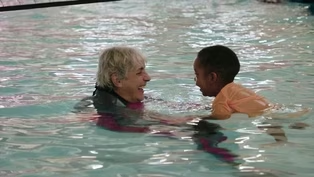
ISABELLA JIBILIAN: Wayne Willis and his family are working to reverse that trend through their business Orca Aquatics.
His son Dylan coaches, the swim team, and his daughter Sydney and wife Joanna gives swim lessons.
Some of these students are able to learn for free thanks to former State Representative Ray Rickman.
RAY RICKMAN: Our number one goal is to teach now low income children to swim and to avoid drowning.
ISABELLA JIBILIAN: He started a program called Spoon Empowerment to sponsor swim lessons for black and low income youth.
2,600 children have learned to swim through the program so far.
MARA GAY: The reason so many Americans can't swim is because they don't have safe places to learn to do so.
Public pools are the critical piece of this puzzle.
So it would be the equivalent of calling for education for all Americans without having any schools.
ISABELLA JIBILIAN: In August, a chlorine explosion shut down the pool where orca aquatics holds its lessons until the damage is fixed.
They're teaching at a different pool, but have had to cut back swim lessons from seven days a week to three.
The shortage of pools in the area has inspired Ray Rickman to expand his mission.
RAY RICKMAN: A $20 million Olympic plus swimming pool for the people of Providence to come free to swim and we're going to get it done.
ISABELLA JIBILIAN: Rickman hopes that one day everyone in his community will have a place to swim.
For PBS News Weekend, I'm Isabella Jibilian in Providence Rhode Island.
LISA DESJARDINS: Now online a hot topic in my neighborhood, at least to rake or not to rake and experts tips on eco-friendly autumnal lawn care.
All that and more is on our website pbs.org/news hour.
And that's it for our program for tonight.
I'm Lisa Desjardins.
For all of my colleagues, thanks for being with us.
And we hope you'll join us again this time tomorrow.
(BREAK) END

Advice for talking with kids about the Israel-Hamas war
Video has Closed Captions
A child psychologist’s advice for talking with kids about the Israel-Hamas war (6m 12s)
Aid arrives in Gaza as Israel prepares to step up attacks
Video has Closed Captions
Humanitarian relief arrives in Gaza as Israel prepares to step up attacks (3m 53s)
Swim safety advocates aim to undo historic racial inequities
Video has Closed Captions
Swim safety advocates aim to overcome historic racial inequities (4m 49s)
UN aid chief hopes to increase flow of supplies to Gaza
Video has Closed Captions
UN aid chief hopes to increase flow of critical supplies to Gaza (6m 46s)
Providing Support for PBS.org
Learn Moreabout PBS online sponsorship
- News and Public Affairs

FRONTLINE is investigative journalism that questions, explains and changes our world.

- News and Public Affairs

Amanpour and Company features conversations with leaders and decision makers.












Support for PBS provided by:
Major corporate funding for the PBS News Hour is provided by BDO, BNSF, Consumer Cellular, American Cruise Lines, and Raymond James. Funding for the PBS NewsHour Weekend is provided by...