
US Winter Salad Bowl
4/13/2026 | 26m 30sVideo has Closed Captions
U.S. winter “salad bowl.” Florida farmers feed the hungry. Montana growers raise gluten-free crops.
“Heads will roll” in this southwestern farm field…as farmers harvest lots and lots of lettuce from America’s winter salad bowl. Growers down south step up efforts to help the hungry as part of “Farmers Feed Florida.” On Farm to Fork, we’ll learn how to prepare a frittata made with cauliflower. Montana farmers cash in on a growing demand for gluten free farm crops.
Problems playing video? | Closed Captioning Feedback
Problems playing video? | Closed Captioning Feedback
America's Heartland is presented by your local public television station.
Funding for America’s Heartland is provided by US Soy, Sustainable Agriculture Research and Education, Rural Development Partners, and a Specialty Crop Grant from the California Department of Food and Agriculture.
US Winter Salad Bowl
4/13/2026 | 26m 30sVideo has Closed Captions
“Heads will roll” in this southwestern farm field…as farmers harvest lots and lots of lettuce from America’s winter salad bowl. Growers down south step up efforts to help the hungry as part of “Farmers Feed Florida.” On Farm to Fork, we’ll learn how to prepare a frittata made with cauliflower. Montana farmers cash in on a growing demand for gluten free farm crops.
Problems playing video? | Closed Captioning Feedback
How to Watch America's Heartland
America's Heartland is available to stream on pbs.org and the free PBS App, available on iPhone, Apple TV, Android TV, Android smartphones, Amazon Fire TV, Amazon Fire Tablet, Roku, Samsung Smart TV, and Vizio.
Providing Support for PBS.org
Learn Moreabout PBS online sponsorship>> Hi I'm Rob Stewart.
We have plenty of produce to share with you on America's Heartland this time with some warm weather harvests, some answers on gluten free oats and a vegetable recipe that's just a bit different.
Where do you go for fresh salad fixings when it's way too cold to grow anything in your garden?
We'll take you to Arizona and some farmland that's been called America's winter salad bowl.
Then, growers in the Sunshine State step up in efforts to help those less fortunate with a program called "Farmers Feed Florida".
We'll take you to Montana where "gluten free" is part of the business plan for these special farm families.
And Sharon Profis steps into the kitchen to share a very different way to prepare cauliflower.
It's all coming up on America's Heartland ♪♪ >> America's Heartland is made possible by: >> America never stops.
Neither do the farmers and ranchers who call her home.
And as rural America grows further, Farm Credit will be there.
Just as we have for one hundred years.
>> CropLife America.
Representing the companies whose modern farming innovations help America's farmers provide nutritious food for communities around the globe.
>> The Fund for Agriculture Education.
A fund created by KVIE to support America's Heartland programming.
Contributors include the following: ♪♪ You can see it in the eyes of every woman and man ♪♪ ♪♪ In America's Heartland, livin' close to the land ♪♪ ♪♪ There's a love for the country ♪♪ ♪♪ And a pride in the brand ♪♪ ♪♪ In America's Heartland ♪ ♪♪ Livin' close... close to the land ♪♪ ♪♪ >> We're so glad you could come along with us on America's Heartland this time.
We're going to do a little coast to coast traveling and spend some time in the Great Plains as well.
And we're going to pick a little produce to get us going.
We'd all love to get VERY fresh vegetables from our own gardens, but that's not always practical and almost impossible when the snow is flying in those winter months.
But, winter is the prime growing season for lettuce in one part of the heartland.
♪♪ >> Great in salads, lettuce is one of the most popular vegetables at your supermarket.
American farmers will produce one quarter of the lettuce grown on earth.
But the green and leafy favorite is highly perishable - which means the challenge for growers is to pick it, pack it and get it to consumers.
>> I would say millions of people have eaten ours and our neighbor's lettuce grown in this area.
>> The average American will consumer about 30 pounds of lettuce each year.
Much of it comes from these fields near Yuma, Arizona.
>> We produce this product as a collective and we all have pride in it.
We want the market to have a good reputation.
>> On this late February afternoon, farm workers spread across the fields to harvest different kinds of lettuce from iceberg to romaine.
>> How soon will this be to a consumer?
Will this be on someone's table?
>> Two days to two weeks, depending on where you're at in the US or Canada.
>> You service some of the largest fast food chains in the country.
>> There's a bunch of growers here in Yuma that produce for companies that supply all of those large restaurant chains with consistent product throughout the year, day in and day out, year round.
This area here in Yuma is a, salad is big business here.
>> That's what we're looking for.
>> Yeah, looks gorgeous.
>> Kent Inglett and John Boelts farm three thousand acres of land in southwest Arizona and... >> These days, farmers must look beyond picking and packing to meet consumer demand.
In the lettuce game, presentation and preparation are also important.
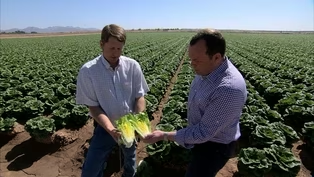
>> The way that it's handled in the field for use in Romaine hearts later on is, they'll take and take the bottom off, which we call tailing, and they'll take the top off, which the crews are a lot better at it than I am.
>> They do this in the field?
>> Then they'll drop the outside leaves.
And that's what you're left with, which is a heart of Romaine.
>> It's beautiful.
>> And what the customer's looking for, when you're all finished doing all that, when it goes through processing.
>> Oh look, there it is.
>> They're looking for the two different colors of lettuce, so you have a nice color contrast on your plate when you're serving.
>> There's your Caesar salad.
>> John and Kent credit their contract workers for helping to make the business successful.
Many in these fields are Mexican citizens who commute into the U.S.
daily to bring in the year round harvests.
>> You know, hands on stuff that people do, it's a true craftsmanship trade.
And to do what some of the folks on our crews do, or some of our tractor drivers or irrigators do, a lot of people talk about ag labor not being skilled.
Whether you're driving a combine in the Midwest harvesting grain, or you're cutting lettuce and trucking it to market, it's highly skilled labor.
>> Come on, it's picnic time!
Come on Daisy!
Come on kids!
>> A midday meal here often means lunch alongside the fields.
>> This is Romaine lettuce that we just harvested about an hour ago from there.
>> What's your favorite food?
>> Lettuce >> And why is lettuce your favorite food?
>> Because daddy grows it!
>> What does it mean to you to know that you guys really are supplying a product to the entire country?
>> I think it gives you a sense of pride that you're producing not just a product, but something that helps people grow and helps families and is healthy for families as well.
It gives you a sense of knowing that it's worthwhile.
John does work a lot of hours being a farmer, but it is something worthwhile.
>> John and Kent don't know yet if their youngsters will be "a next generation of farmers."
What they do know is that their fields of green have become their fields of dreams.
>> The lifestyle it affords me.
We do work a lot of hours but we can spend a lot more time with our family.
It's more a traditional way of life for us and that's just the way I choose to live my life.
>> If "iceberg" lettuce is on your salad plate, you may be interested to know that before the 1920's "iceberg" was better known as "crisp head" lettuce.
The name change came when the round heads of lettuce were covered with crushed ice for shipping to eastern markets.
>> Getting those fruits and vegetables into your diet is important in maintaining good health.
But what about those communities helping people who can't afford to buy what they need or even access fresh produce in their neighborhoods.
Well, our Jason Shoultz takes us to Florida to meet some farmers doing their part to help those less fortunate.
♪♪ >> The cucumber harvest is well underway this morning at Long and Scott Farms in central Florida.
>> But these cukes will never make it to your supermarket.
And the folks picking the produce aren't farm workers.
They're volunteers - doing what's called "gleaning" harvesting produce that's perfectly fine but not marketable.
>> So what are you looking for when you're picking these out?
>> You want to get the ones that aren't split, and these are all still pretty healthy looking, they're hiding underneath the leaves here, but you can find them in-between.
>> It's pretty amazing that the farmer isn't planning to pick this field anymore.
>> Yeah, it's just awesome that he's donating the rest of this crop to a good cause.
>> The impact of this "act of kindness" grows with every five pound bag on the pile.
And it goes beyond the field.
>> There's pickles out there on those vines.
There are a lot of good ones still left.
Chances are there's not enough to make it feasible for us to back through the field but there's still a lot of good fruit on those vines that edible and can feed a lot of folks.
>> This is the sorting shed at Long and Scott Farms where workers sort cucumbers by shape and size.
The long green produce will be shipped to markets up north or end up getting pickled.
But many of the cucumbers aren't the "right size" for pickling.
♪♪ >> Those cucumbers thousands of them end up in these big boxes.
A donation worth tens of thousands of dollars made by Hank Scott to Florida food banks.
Hank participates in the "Farmers Feeding Florida" food recovery program - connecting farmers with Florida food banks.
>> You hate to see a crop that you've worked so hard to grow to go to waste.
I mean you're growing it to feed people; you want it to feed people.
if you can get the stuff that's not marketable in the right hands where it can help people that are in need--that's the greatest thing in the world, the greatest feeling in the world.
>> So it is just huge for somebody like Hank Scott to to step up and actually donate this amount of product.
Because, you know, there's a cost to it, you know?
And there's a cost of getting it out of the field.
And there's a, you know, getting it in to our trucks.
>> It may be a concept that's hard to wrap your mind around.
Here - in Central Florida where an abundance of fresh produce is grown - many families face hunger issues.
>> We've been really hard-hit by the economy here in Florida.
As you probably know, we were sort of ground-zero for the foreclosures in the country.
Florida is ranked 8th in the nation in food hardship.
>> At the same time many of Hank's neighbors are having trouble buying food, amazingly much of the crop he grows actually could end up rotting in the field!
If the market price for his crop is too low, Hank actually loses money by hiring people to harvest!
It's a dilemma faced by farmers across the US.
>> Yeah, and it's one of those variables you got no control of and that's the market, When all the variables come together, and the stars are aligned, and everything is just right and you get good yields, and there's just too much produce around, you know, the prices will be half what they were the year before and that's tough.
>> Not only is it not worth it to us, it doesn't pay us to go harvest it, but we can't even afford to give it away, really.
It's too expensive to give away.
And that's where the food bank comes in.
They've got the avenues to move this stuff and get it to the right people, and that what's works great.
>> If we could get one percent of the surplus commodities that are grown here, that would be equivalent to about 60 million pounds of product a year.
So that's one percent of the surplus.
>> While having volunteers harvest donated crops like these cucumbers may seem like a no-brainer, it can be a tough sell for farmers concerned about legal and liability issues.
But as food banks work to meet a growing demand, they're increasingly turning to neighbors in the agricultural community.
>> Farmers are a, there's a natural hesitation.
I could totally understand it, at the onset that, "Wow, if I donate this food, what if somebody gets sick from this?"
The people that are eating this food their immune systems are already compromised, you know?
And that's a legitimate concern.
But there's a Federal law in place, the Good Samaritan Act has been around since 1996, you know?
And it's in place and it protects any food donor from legal liability.
God-forbid somebody gets sick from that food.
>> I think sometimes you can over worry about legal issues.
You know, I think when it comes to doing something like this they take care of themselves.
You know, you're doing something good, you're doing something right.
I just don't think legal issues don't even enter my mind when it comes to that stuff.
>> Not far from Hank's farm, the cucumbers are being boxed by Boy Scout volunteers at the Second Harvest food distribution center.
They'll end up at food pantries and hunger programs all across the region.
And while the team here says they appreciate pre-packaged food donations, produce like this is especially important to those facing hunger.
>> A nutritious and delicious donation... fresh from the farm.
>> Florida is the number one producer of cucumbers in the United States.
And while botanically a fruit, cucumbers are generally thought of as vegetables.
The fruits... or vegetables... originated in India where they've been raised for some three thousand years.
>> We've been talking about different kinds of vegetables on the show this time, but do you find yourself serving the same kind of produce again and again?
Want to try something different?
How about a vegetable that early Italians called "Flowered Cabbage".
It's not as popular as its green cousin - broccoli - but cauliflower packs a wallop when it comes to great nutrition.
So how to serve it?
Sharon Profis in the kitchen with some tasty ideas.
♪♪ >> I almost always have cauliflower in my fridge; it has a really subtle flavor that you can use in a lot of ways.
So today we're making a Cauliflower & Chorizo Frittata that comes together really fast.
When you're shopping for a cauliflower there are a couple of things to look out for.
First make sure that its leaves are bright and green, and that this part is really firm, that means it's fresh.
You also want to look out for a cauliflower that's pretty heavy for its size.
This one is small but it's heavy, so I know it's good.
Now, I know what you're thinking.
Cauliflowers are really messy.
If you cut them the wrong way, you'll end up with a bunch of little crumblies all over your cutting board, so I want to show you a trick to breaking down a cauliflower so that it's really clean.
The first thing to do is remove the stem.
I'm just going to put my knife in there and just help it get away from the cauliflower head, and it should pop out just like that.
Now at this point you can pick off whatever leaves are left, and we're going to remove the florets from the inside out, so grab your knife and then pop them out just like that.
♪♪ >> For the Frittata though I don't want these big sections.
The way you cut it in half is not through the top, it's through the stem, and that way, it'll split on its own, and again no crumblies.
We'll put them right in the pan.
When you go to the Farmers Market or the grocery store, you might see cauliflower in a variety of colors, there's orange that's also called Cheddar Cauliflower, and there's even purple and green which is actually Romanesco, a cross between broccoli and cauliflower.
Also going into the frittata is a minced garlic clove, some cilantro, and green onion, which will complement the chorizo very nicely.
Now that our ingredients are prepped, we can move over to the stove to make our frittata.
We can't just put the cauliflower raw into the frittata, what we first have to do is steam it to soften it a little bit since it needs a little bit longer to cook, so I have in here our cauliflower, some water, and to make sure that the cauliflower doesn't lose its color, just a little bit of salt.
I have it over high heat, and we'll let it steam until it just starts to soften.
When the cauliflower just starts to break apart with a spoon, then it's done.
So I'm going to transfer it to a plate, so that we can sauté our chorizo, we'll do about half a cup, and chorizo is basically just ground pork seasoned with a bunch of spices, which is great because that's going to take care of our seasoning for this dish, so just break it apart with a spoon.
Now it's time to add the garlic, you never add it too soon otherwise it might burn, and all we're looking for here is for the chorizo to be just cooked.
Now we can add our cauliflower back into the mix, get it a little bit brown.
Oh my goodness!
I could eat this, like this, right now.
We already prepared our green onion and cilantro, but to that I'm going to add about a table-spoon of Dijon mustard, I'm also adding a quarter cup of parmesan cheese to the mix, reserving a little bit more to sprinkle on the top, and, now we'll add 6 eggs, hit it with a little salt, scramble them up, make sure that this is all evenly distributed so that every piece gets an equal bite of chorizo and cauliflower, and goes into the pan.
Before it has too much time to set you can take a moment to make sure that there's egg everywhere, in all little nooks and crannies, still have cheese left, so sprinkle that parmesan right on top.
I also want a little gooey effect, so I'm adding mozzarella cheese to this.
Alright, alright, that's enough cheese, so we'll let this cook on the stovetop for about 5 minutes so that the bottom sets and then it goes into the oven at 375 degrees for about 10 minutes until it's no longer liquidy, then you have a beautiful frittata that's ready to be served immediately.
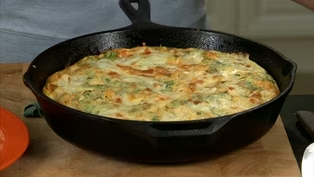
Check out this stunning frittata, all the colors from the chorizo, and the green onion, and the cilantro, and I love how some of the cauliflower is just peaking up.
So let's serve this up.
And there you have a one-pan meal that's so satisfying and really highlights just how amazing cauliflower is.
And now all that's left to do is eat.
♪♪ Now that you're set to include cauliflower in your dinner plans, let's give you some advice on how to handle the veggie after you head home from the supermarket.
Food experts suggest that the best way to keep cauliflower fresh is to store it.... unwashed.... in a plastic bag in your refrigerator.
They also suggest you store the cauliflower.... with the head turned down.
>> A balanced diet means more than just fruits and vegetables.
And while grains like wheat, barley and rye deliver important proteins and healthy fats, they also contain gluten.
Gluten is a protein that can adversely affect some with gluten sensitivity.
Which is why.... oats are high on the list of those trying to avoid gluten.
Our Kristen Simoes says that's provided some new opportunities for farmers in Montana.
♪♪ >> It's harvest time for Bruce Wright on his family farm in Bozeman, Montana.
>> We grow some wheat and barley and hay and peas and some sunflowers.
And then a specialty oat that we're working on.
>> That "specialty" oat now covers acres of land here.
And for a farm with roots dating back to the 1800s, that oat is changing the future for this farmer and for thousands of people who suffer from gluten sensitivity.
>> The oats are special because they are a variety that was developed by Montana State University.
And what we've found in these oats is that they are a hull-less variety of oat and they're very low in allergens.
And oats in general don't have any gluten in them so we can take these oats and process these oats and make them into oatmeal and porridge and flour and stuff that can be eaten by people who have gluten sensitivities.
>> "Gluten" is a natural protein composite found in grains like wheat, barley and rye.
It gives texture and elasticity to dough.
It's also used as a flavor enhancer and thickener which means you'll find it in everything from soups to salad dressings.
"Gluten free" labeling on products at the supermarket is important for those suffering from Celiac Disease which is associated with intolerance to gluten in grains.
>> The demand is growing because the awareness of celiac disease and gluten intolerance is growing.
now the doctors are becoming more aware of celiac disease, gluten intolerance, so it's becoming more diagnosed and more people are paying attention.
>> Producing this product is high-tech, high cost and high science.
The combines used to harvest these oats won't be used for other crops- for fear of cross contamination.
The oats are hauled to a processing plant to pass through a series of cleanings and crushings.
>> From there it goes into the second cleaner, does more of the same thing, cleans it out.
Goes from that second screening machine into a series of stacked indent cleaners.. Then it goes up into the roller mill.
That's what takes and rolls the oat into a flake and what we usually call oatmeal.
>> Their focus is to provide specialized crops for gluten free products to meet an increasing demand from consumers.
>> These are your short oats these are the ones we want and you haven't seen these before in the field.
>> Dr.
David Sands has been working with Bruce on food production for the past eight years.
>> How important are farmers in, in getting new products like this to the market?
Dr.
David Sands: Well if they don't grow it, it won't happen.
So you have to produce a crop that they want to grow, that makes a difference in, in their income, and also they are growing food crops.
They are as interested in the human consumer as anybody else.
>> What they're interested in is the different varities... >> Laboratory work at Montana State University centers on testing oat varieties... >> The overall goal is to make a more perfect food.
A food that is designed around our genomes and our genomes are different so you're going to have these different groups of people wanting different things.
And why shouldn't they, and why shouldn't we produce exactly what they want.
>> And for those consumers "wanting" gluten free blueberry pancakes, Bruce and others can stop by Bozeman's Main Street Over Easy Restaurant.
>> It is really gratifying.
When you talk to somebody who hasn't been able to eat, uh, bread or something like that, they, they're so happy to be able to have that again, they really, really appreciate their food.
>> I love what I do.
I love being able to grow things, I love to be out here in the countryside, uh, and the beautiful scenery, one of the most beautiful spots.
I, I'm so lucky to get to work here.
>> Before we go.... just a reminder that we have lots to share with you on our America's Heartland website.
You'll find us at AmericasHeartland.org.
And don't forget you can also hook up with us on Facebook, or check out our America's Heartland videos on You Tube.
Lots of choices to connect with us online.
That's going to do it for us this time.
Thanks for travelling the country with us on America's Heartland.
♪♪ You can see it in the eyes of every woman and man ♪♪ ♪♪ In America's Heartland, livin' close to the land ♪♪ ♪♪ There's a love for the country ♪♪ ♪♪ And a pride in the brand ♪♪ ♪♪ In America's Heartland ♪ ♪♪ Livin' close... close to the land ♪♪ >> America's Heartland is made possible by: >> America never stops.
Neither do the farmers and ranchers who call her home.
And as rural America grows further, Farm Credit will be there.
Just as we have for one hundred years.
>> CropLife America.
Representing the companies whose modern farming innovations help America's farmers provide nutritious food for communities around the globe.
>> The Fund for Agriculture Education.
A fund created by KVIE to support America's Heartland programming.
Contributors include the following: ♪♪
 New
NewVideo has Closed Captions
Farmers harvest lots and lots of lettuce from America's winter salad bowl in Arizona. (4m 44s)
 New
NewFarm to Fork Cauliflower Frittata
Video has Closed Captions
On Farm to Fork, we’ll learn how to prepare a frittata made with cauliflower. (6m 36s)
 New
NewVideo has Closed Captions
Growers down south step up efforts to help the hungry as part of “Farmers Feed Florida.” (6m 24s)
 New
NewVideo has Closed Captions
Montana farmers cash in on a growing demand for gluten free farm crops. (4m 48s)
Providing Support for PBS.org
Learn Moreabout PBS online sponsorship
- Food
Christopher Kimball’s Milk Street Television
Transform home cooking with the editors of Christopher Kimball’s Milk Street Magazine.




Support for PBS provided by:
America's Heartland is presented by your local public television station.
Funding for America’s Heartland is provided by US Soy, Sustainable Agriculture Research and Education, Rural Development Partners, and a Specialty Crop Grant from the California Department of Food and Agriculture.