
Broadway Musicals: A Jewish Legacy
Season 40 Episode 6 | 1h 23m 24sVideo has Closed Captions
Find out why the Broadway musical has proven to be a fertile territory for Jewish artists.
Narrated by Broadway legend Joel Grey, this documentary explores the role of Jewish composers and lyricists in the creation of the modern American musical and showcases the work of some of the nation’s preeminent creators of musical theater including Irving Berlin, Jerome Kern, George and Ira Gershwin, Lorenz Hart, Richard Rodgers, Oscar Hammerstein II, and more.
Problems playing video? | Closed Captioning Feedback
Problems playing video? | Closed Captioning Feedback
Major series funding for GREAT PERFORMANCES is provided by The Joseph & Robert Cornell Memorial Foundation, the Anna-Maria and Stephen Kellen Arts Fund, the LuEsther T. Mertz Charitable Trust, Sue...
Support provided by:

Broadway Musicals: A Jewish Legacy
Season 40 Episode 6 | 1h 23m 24sVideo has Closed Captions
Narrated by Broadway legend Joel Grey, this documentary explores the role of Jewish composers and lyricists in the creation of the modern American musical and showcases the work of some of the nation’s preeminent creators of musical theater including Irving Berlin, Jerome Kern, George and Ira Gershwin, Lorenz Hart, Richard Rodgers, Oscar Hammerstein II, and more.
Problems playing video? | Closed Captioning Feedback
Where to Watch Great Performances
Great Performances is available to stream on pbs.org and the PBS app.
Great Performances Newsletter
Subscribe to the Great Performances newsletter to keep up with the latest full episodes to stream, exclusive content, and more!Providing Support for PBS.org
Learn Moreabout PBS online sponsorshipMore from This Collection
Find your front row seat at home and watch acclaimed Broadway productions, from Noël Coward’s Present Laughter to 42nd Street.

An Evening with Nicole Scherzinger
Video has Closed Captions
Nicole Scherzinger performs at London’s Royal Albert Hall for the first time. (1h 23m 15s)
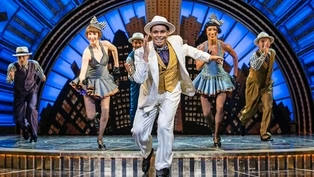
Video has Closed Captions
Directed and choreographed by three-time Tony winner Kathleen Marshall. (2h 10m 8s)
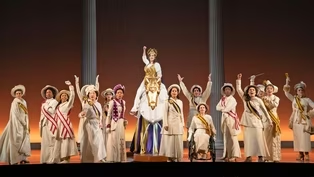
Video has Closed Captions
Recorded from Broadway, this musical tells the story of the American suffragist movement. (2h 14m 15s)

Video has Closed Captions
Experience this Cole Porter classic musical starring Tony winner Stephanie J. Block. (2h 24m 55s)
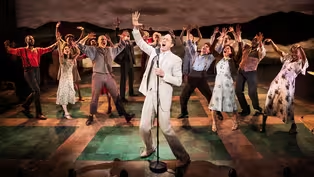
Video has Closed Captions
Experience this musical by Conor McPherson featuring the music of Bob Dylan set in 1934 Minnesota. (2h 13m 31s)

Video has Closed Captions
Enjoy Tony winner David Henry Hwang’s Broadway comedy starring Daniel Dae Kim. (1h 45m 43s)

Video has Closed Captions
Experience this Tony and Pulitzer Prize-winning Broadway musical from London's Donmar Warehouse. (2h 9m 46s)

Rodgers & Hammerstein's 80th Anniversary
Video has Closed Captions
Features an all-star cast at London’s Theatre Royal Drury Lane. (1h 55m 25s)
Video has Closed Captions
The comedic play tells the story of a Black preacher’s scheme to reclaim his inheritance. (1h 45m 24s)

Audra McDonald at the London Palladium
Video has Closed Captions
Audra McDonald performs a repertoire of classic Broadway songs at the London Palladium. (1h 22m 24s)

Video has Closed Captions
Experience this Shakespearean classic directed by Tony Award winner Kenny Leon. (2h 33m 19s)
Providing Support for PBS.org
Learn Moreabout PBS online sponsorshipNext on "Great Performances"... They invented the sound and style of Broadway with some of the greatest s of all time.
I'm trying to think if there was anybody not Jewish.
From its beginnings, Broadway musical theater has always been fertile grd for a wide variety of Jewish-American artists.
Why were so many of them Jewish?
The answers are in the songs, the shows, and "Broadway Musicals: A Jewish Legacy."
♪♪ Major funding for "Great Performances" is provided by... ...and by contributions to your PBS station from viewers like you.
Thank you.
Major fund Once upon a time, King Arthur wanted to take his knights on a quest to do a musical on Broadway, but this was a very, very bad idea.
And I'm going to tell you why.
♪ In any great adventure, if you don't want to lose ♪ ♪ Victory depends upon the people that you choose ♪ ♪ So listen, Arthur darling, closely to this news ♪ ♪ You won't succeed on Broady if you don't have any Jews ♪ ♪ You may have the finest sets ♪ ♪ Fill the stage with penthouse pets ♪ ♪ You may have the loveliest costumes and best shoes ♪ ♪ You may dance and you may sing ♪ ♪ But I'm sorry, Arthur King ♪ ♪ You'll hear no cheers, just lots and lots of boos ♪ ♪ You may have butch men by the score ♪ ♪ Whom the audience adore ♪ You may even have some animals from zoos ♪ ♪ Though you've Poles and Krauts instead ♪ ♪ You may have unleavened bread ♪ ♪ But I tell you, you are dead if you don't have any Jews ♪ It's not funny unless it's true.
And people only laugh because they think, "It's true."
Rodgers and Hammerstein.
You can name off all the Broadway composers.
Jerry Herman.
Irving Berlin.
Everybody on Broadway except Cole Porter.
Sheldon Harnick and Jerry Bo.
George Gershwin, Steve Sondheim.
I'm trying to think if there was anybody not Jewish.
♪ OOOOO... ♪ OY!
My husband, Adolph Green, and his wonderful partner, Betty Comden.
And, of course, Lenny Bernstein.
Why were they -- so many of them Jewish?
♪ There simply must be, Arthur, trust me ♪ ♪ Simply must be Jews Is it that they were misfits and then they all found themselves in musical theater because it was a place where, with their unusual brains, they could all collaborate and co-exist in an environment that allowed for that flexibility?
Maybe that was it.
Maybe one day we'll say, "Oh, they all had A.D.D.
and that's why they all ended up in musical theater.
It wasn't about the Jewishness at all."
[ Orchestra playing "There'so Business Like Show Business"] JOEL GREY: For generations of Jewish songwriters, Broadway has been a place for transformation.
On Broadway, the idea of outsiders overcoming obstacles could be dramatized in a uniquely American art form.
On Broadway, melodies from Jewish prayers inspired new songs that would be embraced by millions.
Broadway offered Jewish songwriters a chance to make it in America, and in return, they fashioned an America of their own in songs and shows that are applauded around the world.
"Porgy and Bess" and "Show Boat" and "Oklahoma!"
These are ideas that are fictions.
What do we make America into?
How do we take what we know and make it into America?
The Broadway musical is a sort of tipping point experience where a handful of composers and lyricists created a way for all of us to experience the ideas that have become part of what we call the American dream.
[ Orchestra plays "The Shepherd's Dream" ] GREY: Before the Broadway musical established its home near Times Square early in the 20th century, there was a lively theater that thrived downtown on the Lower East Side, where Yiddishkeit -- meaning "all things Jewish" -- predominated.
There, Russian immigrants like Boris Thomashefsky and his wife, Bessie, pioneered a kind of musical theater which spoke to the multitude of greenhorns fresh off the boat -- the Yiddish theater.
MAN: There is a huge connection between Broadway and the American Yiddish theater.
People don't get that anymore -- about how powerful Yiddishkeit was in the foundation of Broadway, and that the direction of Yiddishkeit was twofold.
It was to amuse, but it was also to instruct, and that the theater could be used, ultimately, as a medium for showing people on stage how certain situations in life might play out.
And hopefully offering them the opportunity to learn from the examples that they saw onstage.
I was a protégé of the great Boris Thomashefsky!
[ Crowd gasps ] Yes, Yes.
He taught me everything I know.
I'll never forget, he turned to me on his deathbed and said, "Maxella, ala menchen al mashen, haden tukka gatsen gashen pishen pipa casen!"
What does that mean?
Who knows?
I don't speak Yiddish.
Strangely enough, neither did he.
Very often in listening to an early Broadway song, you can think that you're hearing a Jewish song.
So there's not all that much difference between a song like "Greena Cuisina"... and the opening of "Swanee."
♪ I've been away from you a long time ♪ ♪ I never thought I'd miss you so ♪ ♪ Somehow I feel, your love is real ♪ ♪ Near you I wanna be GREY: In 1919, composer George Gershwin, working with lyricist Irving Caesar, wrote "Swanee," the most popular song of Gershwin's career.
♪ Swanee, you're calling me ♪ ♪ Swanee ♪ How I love ya, how I love ya ♪ ♪ My dear old Swanee GREY: The song relied on a now shameful convention from the 19th century in which a black-faced minstrel singer longed for a mythic southland.
♪ Waiting for me, praying for me ♪ ♪ Down by the Swanee GREY: By the time "Swanee" was a hit, the 20-year-old Gershwin had been working in the music industry for five years.
Having dropped out of high school, at one point, Gershwin tried to write songs for the Yiddish theater but was rejected as "too American."
The Gershwin family, like so many immigrant families, figured, "Give your kid music lessons because that's one more step up the rung of ladder of assimilation and success.
Give your kids every possible chance."
So they buy a piano for George's brother Ira and it's up on a crane, put through their window of their apartment, and suddenly George goes over and starts playing.
Well, he's been practicing on a player piano.
[ Piano playing "Swanee" ] So he gets music lessons and goes on to become a piano player on Tin Pan Alley, then a Broadway composer.
Ira turns from writing clever light verse to becoming a lyricist.
And Ira's way of keeping up with this very revolutionary musical brother of his is to build lyrics around American slang.
MAN: Ira loved to use colloquial expressions in his writing.
The best example of that, that I know, is one weekend, probably in about 1936, Ira and his wife Leonore came to spend the weekend with my parents.
My father manufactured tomato products.
And during the course of that weekend, Ira said to my father, "Tell me, how come you call them tomatoes and your sister calls them tomahtoes?"
And my father said to Ira, "Well, if I called them tomahtoes, the farmers that I buy them from would not know what I was talking about."
And everybody forgot about it.
♪ You like potato and I like ♪ ♪ Potahto?
♪ You like tomato and I like ♪ ♪ Tomahto ♪ Potato ♪ Potahto ♪ Tomato ♪ Tomahto ♪ Let's call the whole thing off ♪ ♪ But oh ♪ If we call the whole thing off ♪ ♪ Then we must part ♪ And oh ♪ If we ever part, then that might break my heart ♪ ♪ So if you like pajamas and I like pajammas ♪ ♪ I'll wear pajamas and give up pajammas ♪ ♪ For we know we need each other so ♪ ♪ We better call the calling off off ♪ GREY: The same year that George and Ira began writing shows together for Broadway, George was commissioned to write a piece for an evening of experimental music.
The result was "Rhapsody in Blue."
MAN: How does Gershwin start the "Rhapsody in Blue" but with a Klezmer clarinet.
You can hear... ♪ Doyo-doyo-dah We could be talking about Romania here.
You know, I mean it's pure Yiddishkeit, you know.
But he cloaks it within, you know, classical forms that are contemporary, modern, modern classical music influenced with jazz.
So his music really is a melting pot.
It becomes a reflection of the American experience.
FURIA: George Gershwin was always experimenting, trying to bring jazz and blues and ragtime -- basically black music -- into mainstream Broadway musicals.
MAN: There's a big affinity between the Jewish wail that you hear in the temple and the black spiritual or the blues.
I think a lot of it has to do with the minor key.
I think it also has something to do with bent notes and altered chords.
The blues scale has a kind of built-in minor-ness to it.
That blue note is... Well, I guess it's a blue note, though it existed before the blues, is, you know, the... that... Doesn't that kind of sound Jewish to you?
Yeah.
It's the kind of little flat thing as opposed to, if I'm in the key of C, you know.
Sounds sort of Episcopalian.
I mean the Jewish thing, it's... it's all minor.
Because, you know, Jews and their misery.
The blacks, amazingly, always still had a little faith and hope.
So they're at odds.
Not the Jews.
[ Excited murmuring ] LEHMAN: Ira collaborated with George on one of the songs for "Porgy and Bess."
It is a song that debunks the Bible.
♪ It ain't necessarily so It ain't necessarily so.
The things you're liable to read in the Bible, it ain't necessarily so.
♪ The things that you're liable to read in the Bible ♪ ♪ It ain't necessarily so That line is actually lifted from the liturgy because when you're called up to the Torah in the temple on Saturday, you have to make a blessing, and you say... [ Singing in Hebrew ] which is the same thing as... ♪ It ain't necessarily so ♪ So to borrow a prayer over the Bible for a song that debunks the Bible seems to me to be the very definition of hutzpah, cheekiness.
♪ Wadoo, zim bam boddle-oo ♪ Hoodle ah da wa da LEHMAN: They were very clever.
Has lines like, about Jonah, "He made his home in that fish's ab-do-men."
♪ Oh, Jonah, he lived in the whale ♪ ♪ Oh, Jonah, he lived in the whale ♪ ♪ For he made his home in that fish's ab-do-men ♪ MAN: Tunes written by Jews for non-Jewish audiences.
The greatest ones have all been re-versioned by the greatest African-American jazz artists.
[ Jazz plays ] Some of the most important examples of jazz improvisation come from Gershwin tunes.
That back and forth, that may not always be a cordial one, it might be a contentious one, but I just love that there's a dialogue going on.
I like that there's a battle.
I like that there's a sense of , "Oh, you wrote this?
I'm gonna rewrite it.
You were inspired by this thing I did, now I'm going to take your inspiration and I'm going to redo it and take it one step higher."
That sense of a kind of friendly competition runs throughout American pop music.
FURIA: All of these songs that were created, first on Broadway and later in Hollywood, have really become a part of our collective culture.
And it's amazing that this great body of American song was produced by a handful of people, most of them Jewish.
Starting with people like Jerome Kern, Irving Berlin and Harold Arlen, George and Ira Gershwin, Richard Rodgers and Lorenz Hart, all Jewish songwriters.
GUETTEL: I think Broadway was like a little Jewish club.
And it's still a little Jewish club.
It's a wonderful club to be in.
My father couldn't wait to go to work.
He didn't want to do anything else but work.
Daddy met Larry Hart through friends, and in a very short time, they understood the same things that they wanted out of the musical theater, and nobody had done it yet, and they got along wonderfully.
Gentlemen, you're about to be interviewed.
Wait'll I fix my tie.
Don't you like being interviewed?
Well, I don't mind.
As long as you don't ask us which we write first, the words or the music.
I'm not going to ask you that.
GREY: Richard Rodgers and Lorenz Hart lived uptown.
They came from successful families and both attended Columbia University, but getting their songs to Broadway wasn't easy, as they re-enacted a few years later for the movie cameras.
It's all your fault.
My fault?
All you did was talk about your lyrics.
Why didn't you let me play the music for them?
I'm sick of this racket.
Now you'll have to go into the real estate business with your father.
Come on.
GREY: Just as Rodgers was about to give up music and go into the babies' underwear business, the team struck gold with a song that turned their hometown into an "isle of joy."
Manhattan!
We'll have Manhattan, the Bronx, and Staten -- MAN: ♪ Island too ♪ ♪ It's lovely going through the zoo ♪ ♪ It's very fancy on old Delancey Street, they say ♪ The song "Manhattan" starts with these Lower East Side streets.
It starts with Delancey Street and Mott Street but it expands exponentially.
It goes to Central Park.
It goes to Coney Island.
It goes to the theater district.
Their dreams were taking over all of Manhattan, and, of course, that's exactly what they did in their song.
GREY: While Rodgers and Hart rhapsodized about the Lower East Side in song, this predominantly Jewish neighborhood was one of the most congested places on earth, frighteningly crowded, noisy and filthy.
Out of this rough and tumble world would emerge America's greatest songwriter.
FURIA: In 1893, Irving Berlin, then five years old, gets off the boat at Ellis Island in New York.
His earliest memory as a child growing up in Russia was of a pogrom, a vigilante attack on his Jewish village.
And he remembers hiding in a ditch with his brothers and sisters and parents, watching Russian Cossacks burn down their village.
Then he comes to America, gets off the boat, looks around him, sees all these Americans, and he says, "We stood there in our Jew clothes."
He realized how different he was from everybody else.
GREY: His father was a cantor who taught him how to sing the prayers in synagogue, but Berlin was drawn to all of the different kinds of music he heard on the streets.
The ethnic songs were very popular at that point.
So there was "Sadie Salome, Go Home!"
There was the "Yiddishe Nightingale," a beautiful song.
"The Yiddishe Professor."
"Jake, Jake, the Yiddisha Ball Player."
There was also, "Oh, How That German Can Love."
There was "Sweet Italian Love."
And so forth.
They were humorous love songs.
[ Orchestra plays ] GREY: Berlin was soon writing songs for Broadway revues like the Ziegfeld Follies and for shows built around talents such as the Marx Brothers.
Ah, how do you do?
Are you boys giving me the run around here?
Come over here.
♪ And I'll be there with you ♪ ♪ When my dreams ♪ ♪ Come true ♪ Berlin wanted to write popular songs for a multi-ethnic America.
And as time went on, the business of pop song writing, Berlin became the kind of poster boy for the immigrant Jewish sensibility transformed into the mainstream American.
GREY: For many, becoming American meant changing your name.
Israel Baline became Irving Berlin.
Jacob Gershowitz, George Gershwin.
Isidore Hochberg morphed into Yip Harburg, who wrote the lyrics to "The Wizard of Oz," with composer Hyman Arluck, better known as Harold Arlen.
KUN: To be considered American, you've got to sound a certain way, you've got to look a certain way, and if your last name has too many syllables and makes people think of herring, you might not get the job.
♪ Someone's head resting on my knee ♪ ♪ Warm and tender as he can be ♪ ♪ Who takes good care of me ♪ ♪ Wouldn't it ♪ ♪ Be loverly ♪ ♪ Loverly ♪ ♪ Loverly ♪ GREY: Jewish songwriters almost never told Jewish stories.
Instead, the main character might be a downtrodden flower girl with a Cockney accent in Alan Jay Lerner and Frederick Loewe's "My Fair Lady," or a biracial singer passing as white in Oscar Hammerstein and Jerome Kern's "Show Boat."
♪ Fish gotta swim ♪ ♪ Birds gotta fly ♪ ♪ I gotta love one man ♪ ♪ 'Til I die ♪ ♪ Can't help ♪ ♪ Lovin' that man ♪ ♪ Of mine ♪ KUN: One of the ways that Jewish songwriters on Broadway wrote about the experience of being Jewish is by writing about other outsiders.
I'm not going to tell you the story of Jews in America, but I am going to tell you the story of an African-American on a riverboat.
I'm going to use somebody else's story to tell you mine.
The more the Jews are not writing about Jews, I think you could argue is when they're actually writing the most about Jews.
GREY: The lyricist of "Show Boat," Oscar Hammerstein II, was part of a Broadway dynasty.
He was raised Protestant but his grandfather and namesake was a German-born Jewish impresario, whose theaters helped to define Times Square at the turn of the century.
As a teenager, Oscar went to summer camp and not only played sports but learned to put on shows.
For many of Broadway's songwriters, summer camps offered invaluable experiences.
At Camp Paradox, Larry Hart was known as "Shakespeare," because his trunk was crammed with books instead of clothing.
Richard Rodgers went to the same camp, where he wrote songs when he wasn't teaching kids how to swim.
HERMAN: My parents owned a summer children's camp, and I eventually became the drama counselor and put on shows there.
I was learning about those simple songs that became "The Best of Times," that became "Mame" and "Hello, Dolly," without knowing it.
MAN: The camp that I went to let me put on the shows.
I was 13 or 14 years old, but I thought that's the best present anybody ever gave me.
It probably changed my life.
MAN: I was told when I went to Camp Wigwam that Steve Sondheim had gone there, but he said, "I never went to Wigwam, I went to Camp Androscoggin."
GREY: Summer camps were not just initial training grounds for songwriters.
Sometimes lifelong partnerships were formed there.
WOMAN: My father was music directing at this camp and it was really his lucky day when this weird, schlubby guy, Adolph Green, arrived to play the Pirate King in "Pirates of Penzance."
And Lenny had heard about Adolph through Adolph's friends, how Adolph knew everything there was to know about classical music.
On their first meeting, when my father found out that Adolph purportedly knew everything, he said, "Oh, yeah, come over here," and they sat down at the piano and my father said, "What's this?"
And he played something and Adolph would say, "Ravel, Piano Concerto No.
2."
Two seconds, okay.
Played another thing.
"Tchaikovsky's...number 4."
Two seconds, he knew it.
And my father couldn't stump him, until finally he played this one thing.
"What's this?"
And Adolph didn't know what it was.
And Lenny jumped up, grabbed him and kissed him.
He said, "I just made it up on the spot to try to really screw you."
JAMIE: They were best friends forever more, and the thing about Adolph is that he had this kind of impish spirit.
He had this liveliness and this antic quality, and then when Betty Comden became Adolph's working partner, and she was so lively and quick on the trigger and funny and sassy, the three of them had so much fun together.
They really spoke to this zany part of my father.
This monstrous little duet is entitled "Carried Away."
♪ Modern man ♪ ♪ What is it?
♪ ♪ Just a collection of complexes ♪ ♪ And neurotic impulses ♪ ♪ That occasionally break through ♪ You mean, sometimes you blow your top, like me?
♪ I do ♪ JAMIE: If they hadn't come along, maybe my father wouldn't have written musical theater, or certainly not the kind of musical theater that he wrote with Betty and Adolph that was so delightfully fun and goofy.
I mean, after all, he was supposed to be a very serious maestro.
♪ Carried away ♪ ♪ Carried away, I get carried ♪ ♪ Get carried a... ♪ ♪ Way!
♪ GREY: In the 20th century, New York City attracted a large Jewish population.
In the 1920s, nearly one in four residents was Jewish.
Even so, the preponderance of Jewish songwriters on Broadway was, and is, a phenomenon.
JAMIE: They're almost all Jewish, but the great exception that makes you wonder whether it's a rule at all is Cole Porter.
What the hell is he doing in there?
Porter, though he tried very hard to write a successful Broadway show, hadn't succeeded.
Three shows flopped.
And he met Richard Rodgers in Venice and played him some of his songs.
Rodgers knew that this was an immensely talented man.
And Porter confided at one point that he thought that he had finally figured out the secret of writing hits.
"Oh?"
Rodgers said.
"What's that?"
And Porter said, "I'm going to write Jewish tunes."
I asked him if that story were true and he said yes.
And then I thought about it, and I thought, well, gee, you know, Cole Porter... What could be more Jewish sounding than... ♪ You'd be so nice to come home to ♪ ...especially since my father used to sing a song that went... [ Singing in Yiddish ] He used to sing it to me when I was a little boy.
So yeah, that... I wouldn't be a bit surprised if that notion occurred to him.
There's something sort of Semitic about that as well.
♪ Strange, dear, but true, dear ♪ ♪ When I'm close to you ♪ ♪ Dear ♪ ♪ The stars fill the sky ♪ ♪ So in love... ♪ MAN: Yip Harburg, my father, said even Cole Porter was Jewish because back in the Inquisition times, he was really Jewish and they forced him to become a Christian, see?
So, since then... And then Yip would sing some of Cole Porter's songs in a Hebraic Middle Eastern chant, you know.
If you listen to "My Heart Belongs to Daddy," the part in it... ♪ Da-dah-da da-dah-da ♪ that sounds a little like davining... ♪ Da-dah-da da-dah-da da-daddy-ah ♪ ...like praying in temple.
♪ So I want to warn you, laddies ♪ ♪ Though I think you're perfectly swell ♪ ♪ That my heart belongs to daddy ♪ ♪ And my daddy, he treats it so well ♪ GREY: In the mid-1930s, Cole Porter's shows served as a great escape for theatergoers in the midst of the Depression.
♪ My heart belongs to daddy ♪ GREY: Across the ocean in Germany, however, only a fortunate few Jewish families would find a way to escape from the wrath of the Third Reich.
[ Boots tromping ] [ Crowd chanting "Sieg heil!"
] WEILL: I decided to become a citizen on the day on which I arrived here, six years ago.
I remember very well the feeling I had as the ship moved down the harbor past the Statue of Liberty and the skyscrapers.
All about us were exclaiming in amazement at the strange sights, but my wife and I had the sensation that we were coming home.
GREY: Kurt Weill was Germany's leading theatrical composer, but he was also Jewish -- the son of a cantor.
His work, including the popular "Threepenny Opera," had been denounced by the Third Reich for being "degenerate."
January 30th, the reason I remember it is my birthday.
January 30, 1933, not my... my birth date, no, but my birthday, was when Hitler became chancellor of Germany.
Kurt Weill left that day, and a lot of people left that day.
It was a huge exodus.
Goodbye.
They knew.
GREY: Weill and his wife and muse, Lotte Lenya, eventually ended up in the United States, where "The Threepenny Opera" had already been performed on Broadway.
Kurt Weill had already brought his own radical musical revolution to America before he got there.
"Come Join the Army" or... His love of the ambivalence of major and minor in so many of his songs -- "Pirate Jenny."
There are Jewish melodic elements in his music.
But he comes to America and you can see the evolution of musical style as he writes "September Song."
♪ But it's a long long while ♪ ♪ From May to December ♪ ♪ And the days grow short ♪ ♪ When you reach September ♪ GREY: "September Song" from the show Knickerbocker Holiday became Kurt Weill's first popular standard in America.
PRINCE: He was immediately recognized as a great composer.
One of the great landmark shows was "Lady In The Dark."
Moss Hart took his own psychoanalysis and used it as a motivation for writing that show.
No one had seen anything like it.
GREY: "Lady in the Dark" paired Weill with Ira Gershwin, working on his first Broadway show since the premature death of his brother at the age of 38.
A circus dream sequence made Danny Kaye a star when he was able to recite Gershwin's witty list of Russian composers in record speed.
♪ Stravinsky, Rimsky-Korsakoff, Mussorgsky, and Gretchaninoff ♪ ♪ And Glazounoff and César Cui, Kalinikoff, Rachmaninoff ♪ ♪ Stravinsky and Gretchnaninoff, Rumshinsky and Rachmaninoff ♪ ♪ I really have to stop ♪ ♪ The subject has been dwelt upon enough!
♪ ♪ Stravinsky ♪ ♪ Gretchnaninoff ♪ ♪ Rumshinsky ♪ ♪ Rachmaninoff ♪ ♪ We really ought to stop because we all have undergone enough!
♪ [ Applause ] WEILL: What the immigrants of today are bringing to this country is not more and not less than what the immigrants from earlier persecutions have brought here.
All they ever could bring was the work of their hands and the work of their heads.
That's what they offer to this country and what the people of this country are so ready to accept.
Kurt Weill was incredibly, I'd almost say obsessed with the idea of assimilation, obsessed with the idea of being different.
He tried to make it in Hollywood and they said his stuff was too Jewish.
Studio execs said, "Your stuff is too Jewish."
And he was perplexed by that.
He said, "Irving Berlin is a Russian Jew.
I'm a German Jew.
That's the only difference.
We're both Americans."
[ Foghorn blows ] GREY: Though both Kurt Weill and Irving Berlin were Jewish-American immigrants, Berlin's uncanny ability to write songs that felt American was unparalleled.
Berlin humbly claimed he just had a little "knack" for songwriting, but time and again he would create beloved anthems for his adopted country.
FURIA: This is the guy who will so assimilate to America, he will write the most popular Christmas song, "White Christmas."
And even though he's Jewish, writes the most popular Easter song, "Easter Parade."
It's the Horatio Alger story told in Yiddish.
He grows up and becomes the most American of all of us.
♪ God bless America ♪ ♪ Land that I love ♪ ♪ Stand beside her ♪ ♪ And guide her ♪ ♪ Through the night ♪ ♪ With the light from above ♪ That song came from the heart, and it was his thank-you to this country that had taken him in and given him the chance to become who he became.
YESTON: Who would think that in the most American major sounding work that Berlin wrote, there would be in it what I hear very clearly as this.
Well, the Jewish word would be... But it would be a real cantorial... [ Singing in Hebrew ] Well, let's take that... and I'll just put a fundamental bass tone under it.
♪ God bless America ♪ ♪ My home ♪ ♪ Sweet ♪ ♪ Home ♪ [ Applause ] BARRETT: But there were people who protested "God Bless America."
There were ministers who got up in church and said, "What does a Jew have to do with asking God to bless America?"
There was real anti-Semitism.
You know, you didn't feel that in the world of the theater, because that was a world in which nobody knew who everybody was or where they came from, just what they did.
[ Band playing "Alexander's Ragtime Band" ] GREY: "God Bless America" became so popular, it almost replaced the National Anthem.
With the onset of World War II, Jewish songwriters joined the effort to lift the spirits of servicemen and the country at large.
Berlin mounted a new show called "This is the Army," with receipts donated to an army relief fund.
The lyricist Dorothy Fields, who wrote "On the Sunny Side of the Street," cheered up servicemen at the Stage Door Canteen.
And Private Frank Loesser, later known for "Guys and Dolls," wrote the wartime hit "Praise the Lord and Pass the Ammunition."
Servicemen on leave were given free tickets to see Oscar Hammerstein's latest show, created with his new partner, Richard Rodgers.
♪ There's a bright golden haze on the meadow ♪ ♪ There's a bright golden haze on the meadow ♪ ♪ The corn is as high as an elephant's eye ♪ ♪ And it looks like it's climbing ♪ ♪ Clear up to the sky ♪ ♪ Oh what a beautiful mornin' ♪ ♪ Oh what a beautiful day ♪ ♪ I got a beautiful feelin' ♪ ♪ Everything's going my way ♪ GREY: Rodgers and Hammerstein brought a new level of drama to the Broadway musical, often dealing with moral and racial issues for both the characters and the audience to confront.
Hammerstein wrote both book and lyrics, bringing a kind of open-hearted humanitarianism to his work, which informed his personal life as well.
GUETTEL: I think Oscar was a liberal, Jewish in that respect, and cared a great deal about the world.
You can tell by all the lyrics that he wrote.
Like "Show Boat," which was the landmark un-prejudiced musical, that he felt keenly about those things.
He was one of the people who started the Pearl Buck Foundation.
Those children were the product of Asian women and usually American GIs.
♪ Bali Ha'i ♪ ♪ May call you ♪ ♪ Any night, any day ♪ ♪ In your heart, you'll hear it call you ♪ ♪ "Come away, come away" ♪ GREY: In their Pulitzer Prize winning show "South Pacific," Rodgers and Hammerstein dramatized the experience of servicemen and women abroad and delivered an urgent musical plea for racial tolerance.
It's not born in you, it happens after you're born.
♪ You've got to be taught ♪ ♪ To hate and fear ♪ ♪ You've got to be taught ♪ ♪ From year to year ♪ ♪ It's got to be drummed ♪ ♪ In your dear little ear ♪ ♪ You've got to be ♪ ♪ Carefully taught ♪ GUETTEL: "You've Got To Be Carefully Taught" was something that they felt strongly about.
Now they didn't try to do stories just because they could get their political leanings in front of the public.
But it comes up all the time because it's there all the time.
It mattered to them.
♪ There's a place for us ♪ ♪ A time and place for us ♪ [ Singing in Spanish ] ♪ Hold my hand ♪ ♪ And I'll take you there ♪ GREY: As the Broadway musical matured after World War II and issues like bigotry and racism were no longer entirely off limits, director Jerome Robbins began working on a show called "East Side Story" that featured a conflict between Jews and Gentiles.
MAN: Jerry Robbins came to Lenny Bernstein and me to do a contemporary version of "Romeo and Juliet."
One or the other was to be Catholic and Jewish, I forget which, and what finally happened was I realized it was "Abie's Irish Rose" set to music.
That was an enormous hit in the Dark Ages, with a Catholic girl and a Jewish boy.
And so we dropped it.
GREY: "East Side Story" was transformed years later when the creative team found a way to project the fears and tensions of assimilation onto a new group of immigrants.
With a score by Leonard Bernstein and lyrics by a 27-year-old Stephen Sondheim, the show musicalized the conflict between white ethnics and Puerto Ricans finding their way in America.
♪ Lots of new housing with more space ♪ ♪ Lots of doors slamming in our face ♪ ♪ I'll get a terrace apartment ♪ ♪ Better get rid of your accent ♪ ♪ Life can be bright in America ♪ ♪ If you can fight in America ♪ ♪ Life is alright in America ♪ ♪ If you're all white in America ♪ LAURENTS: That's something that has made the show more timely today than it was then.
When the word "immigrant" is said on the stage today, you can feel the whole audience freeze because of all this -- I won't characterize it -- stuff going on in Congress about immigrants.
It's a nation of immigrants, which we are very busy trying to deny.
JAMIE: My father never gave up on the idea that the world could become a better place.
But he struggled with it because all these ghastly calamities kept happening in his lifetime, starting with World War II, really, being the big one, and then the bomb, and then he went through McCarthyism, which was so evil.
So all the way through his life he was constantly doing whatever he could to make the world a better place.
Racism, not the least of these evils, that he was trying to repair.
And I really think he felt somehow that if he wrote a great enough piece of music, he could change the world.
And you can really hear that struggle in "West Side Story."
It's about intolerance and hatred and the misery that that sows in the world.
♪ Somehow ♪ ♪ Someday ♪ ♪ Somewhere ♪ ♪ Let me entertain you ♪ ♪ Let me see you smile ♪ ♪ Let me do a few tricks ♪ ♪ Some old and then some new tricks ♪ ♪ I'm very versatile ♪ ♪ And if you're real good ♪ ♪ I'm gonna make you feel good ♪ ♪ I've been -- something to smile ♪ [GLISSANDO] Forgive me, Steve!
♪ Let me entertain you ♪ ♪ And we'll have a real good time, yes, sir ♪ ♪ We'll have ♪ ♪ A real good time ♪ GREY: Jule Styne emigrated from London and was raised in Chicago, where he became a classical pianist as a young child.
Even with all his talent, he was insecure around the kids at school.
STYNE: I wanted to be liked, wanted applause badly.
And I went out and bought 20 Irving Berlin songs over the weekend, and I memorized them... "Alexander's Ragtime Band" was one of them.
And I played it with all the power I had in my hands, my Beethoven power on "Alexander's Ragtime Band."
And I walked into that gymnasium on Monday afternoon.
I was an instant smash!
GREY: After working as a band leader, a vocal coach, and a top composer in Hollywood, Styne longed for the creative freedom of Broadway.
His score for the landmark show "Gypsy," which starred Ethel Merman, seemed to draw on all of Styne's experiences in show business.
I'd wanted Steve Sondheim to do the whole score.
Merman -- actually, her agent didn't want Steve, so we needed a composer and Jerry Robbins suggested Jule.
MAN: Jule was very fertile, but he came from the old school.
He was not used to writing this integrated stuff, so I would just give him lyrics to set for the most part.
I would write out the rhythms and Ethel Merman belted songs.
What can I say?
♪ That's okay for some people ♪ ♪ Who don't know they're alive ♪ ♪ Some people can thrive and bloom ♪ STYNE: Every star has a trademark and you better deliver that trademark somewhere for that audience.
When I gave Steve the tune to... ♪ Some people ba-da-da-da ♪ But the release goes... ♪ But I... ♪ ♪ But I... ♪ STYNE: At that moment, the audience says, "Oh, there's Merman."
♪ When I think of all the sights that I gotta see yet ♪ ♪ All the places I gotta play ♪ STYNE: Steve understood what that was all about, and when he heard her do it, he knew what I was talking about.
LAURENTS: When we were out of town, it was Easter-Passover and Jule decided to give a seder.
Ethel Merman, who had been born Zimmerman and was always terrified that somebody would think she was Jewish.
She was German, and if you ran into her on the streets in Philadelphia and you said, "What did you do today, Ethel?"
she would say, "Oh I was praying for the show -- in church!"
Anyway, at rehearsals, she always had a turkey sandwich.
So Jule invites her to the seder.
She says to me, "But what am I going to eat?"
I said, "You're not going to have to eat any Christian babies, you'll have capon, which is chicken, Ethel, chicken."
Well, the night came and she dressed very properly, a little black dress, she even seemed to have less hair.
Jule escorted her to the seat of honor.
And she sat down, she opened her bag and took out a ham sandwich and put it on the plate.
And Jule looked at her.
This was his star, but it was his seder.
So he picked up the sandwich and threw it on the floor.
He said, "Ethel, you're insulting the waiters."
And then he turned around, she couldn't see him and he broke up.
GREY: Styne's ability to write great material for renowned singers like Merman was called upon for "Funny Girl," a show based on the legendary Fanny Brice.
[ Orchestra plays, crowd cheers ] ♪ Everyone was singing, dancing, springing ♪ ♪ At a wedding yesterday ♪ ♪ Yiddle on his fiddle played some ragtime ♪ ♪ And when Sadie heard him play ♪ GREY: It was no mean feat to find a performer to take on the role of Fanny Brice.
Fanny was a one-of-a-kind musical talent who could make people both laugh and cry.
After considering a number of versatile actresses, Jule Styne went to a cabaret show down in Greenwich Village.
MARGARET: She opened her mouth, one note came out, and my arm was practically broken because Jule was pressing down so hard.
"This woman must play Funny Girl!"
He was absolutely, right then, convinced, totally, 1,000%, and from there that... was the beginning of "Funny Girl."
♪ Lovers ♪ ♪ Are very special people ♪ ♪ They're the luckiest people ♪ ♪ In the world ♪ ♪ With one person ♪ ♪ One very special person ♪ ♪ A feeling deep in your soul ♪ ♪ Says you were half, now you're whole ♪ ♪ No more hunger and thirst ♪ ♪ But first be a person who needs people ♪ What I wanted to do was take advantage of all these vocal talents that she had.
When you know somebody, it's like you write for Merman, you go further because you know they're going to make it.
♪ The luckiest people in the... ♪ And I accomplished it in "Rain on My Parade."
You know, like how's a girl gonna sing...?
[ Playing tune ] ♪ Life's candy and the sun's a ball of butter ♪ ♪ Don't bring around a cloud to rain on my parade ♪ ♪ Don't tell me not to fly ♪ ♪ I simply got to ♪ ♪ If someone takes a spill, it's me and not you ♪ ♪ Who told you you're allowed to rain on my parade?
♪ ♪ Nobody ♪ ♪ Is gonna ♪ ♪ Rain on my ♪ ♪ Parade... ♪ GREY: In 1964, the same year "Funny Girl" opened, the unimaginable happened -- a musical devoted entirely to a Jewish story came to Broadway.
Seven decades earlier, a violent pogrom had forced Irving Berlin's family to flee their Russian village.
Now a pogrom on stage would disrupt a wedding celebration in a Broadway musical.
We should introduce ourselves.
In place of your usual glamorous hosts, you have two frightened writers today.
This is Sheldon Harnick, who wrote the lyrics to "Fiddler on the Roof."
And this is Jerry Bock, who wrote the music to "Fiddler on the Roof."
And conducting the orchestra today, Milton Green, who conducts the orchestra at the Imperial for us every night.
There was the skeptical feeling that this might not be a universal show, if any show can be termed "universal," appealing to almost everybody.
But this show more than others might be specifically designed for just a certain group of people.
And we had this in mind, without destroying any of the authenticity or the folklore or the color of the show.
We didn't want to limit it just for the appreciation of a small group.
HARNICK: Many people have said, "Oh you were so brave."
We didn't feel that way.
I thought, I'm a Jew, I fought Hitler.
Uh, certainly the American people, we all fought Hitler.
What's so, what's so brave, what's so avant-garde about doing a show about Jews?
So we did.
We did many backers' auditions for the women who sell theater parties, and many of them were Jewish because they represented Jewish groups.
Usually the way the audition would go is that I would explain what the book was in brief, and Jerry Bock and I would then sing some of the score.
♪ May the Lord protect and defend you ♪ ♪ May the Lord preserve you from pain ♪ ♪ Favor them, o Lord ♪ ♪ With happiness and peace ♪ ♪ O hear our Sabbath prayer ♪ ♪ A... ♪ ♪ Men ♪ Hal Prince, who was our producer, after we'd do the backers audition, he would have to get up and really try and convince these ladies that the show was going to be fun and not just a show that had a pogrom at the end of the first act and an exile at the end of the second act.
So Hal had his work cut out for him because these women were very sensitive, and they thought, "Our audiences are not going to like this."
They asked me to direct it, and I said, "I'm the wrong guy.
You've got to get Jerry Robbins or someone like him."
He can give it a universality with movement.
So it won't be just for a narrow audience.
And the first question that Jerome Robbins asked was, What is this show about?
We explained what we thought the show was about and Robbins, to our surprise, said no, that's not what gives these stories their power.
And time and again, at all these meetings, he would say, what is this show about?
And we'd say, well, it's about this, this farmer, and we'd start to describe the plot, he'd say, "No."
And then finally, one day, I believe it was Sheldon Harnick said, "Well, I mean it's about tradition, what else is it about?"
And Jerry said, "That's what it's about, write about tradition."
♪ Who day and night must scramble for a living ♪ ♪ Feed a wife and children, Say his daily prayers ♪ ♪ And still ♪ Ah, that's the old lyric.
Everything evolves.
♪ Who day and night must scramble for a living ♪ ♪ Feed a wife and children, say his daily prayers ♪ ♪ And who has the right as master of the house ♪ ♪ To have the final word at home?
♪ And the daughter's theme was... ♪ And who does Mama teach ♪ ♪ To mend and hem and fix ♪ ♪ Preparing me to marry ♪ ♪ Whoever Papa picks?
♪ ♪ Tradition!
♪ ♪ Tradition!
♪ ♪ Tradition!
♪ ♪ Tradition!
♪ PRINCE: The opening number, "Tradition," was common to every culture, so the show was as common to Japanese family life as it was to Jewish family life.
And it went all over the world, and every single place it went, it became their family story despite the idiosyncrasies of what was Jewish about it.
♪ If I were a rich man ♪ ♪ Yubby dibby dibby dibby dibby dibby dibby dum ♪ ♪ All day long I'd biddy biddy bum ♪ ♪ If I were a wealthy man ♪ ♪ I wouldn't have to work hard ♪ ♪ Iddle-diddle daidle-daidle-dee ♪ ♪ Lord who made the lion and the lamb ♪ ♪ You decreed I should be what I am ♪ ♪ Would it spoil some vast eternal plan?
♪ ♪ If I were a wealthy ♪ ♪ Man... ♪ MASLON: "Fiddler on the Roof" is not just a success, it's a massive blockbuster.
And it opens the door for Jewish stories on Broadway in a way that's absolutely unprecedented.
There are musicals about stories from the Old Testament, musicals set on the Lower East Side with Jewish families.
There's musicals set in the suburbs with Jewish families.
So the fact that you could have a successful Jewish musical just ushers in a tidal wave of Jewish themed shows.
[ Applause ] ♪ Willkommen, bienvenue, welcome!
♪ ♪ Fremde, étranger, stranger ♪ GREY: The time was finally right for Broadway to take on the most sensitive theme in the modern Jewish canon -- the rise of Nazi Germany.
♪ Willkommen, bienvenue, welcome!
♪ ♪ Im Cabaret, au Cabaret, to Cabaret ♪ GREY: The creative team behind "Cabaret" fearlessly dramatized the intolerance that had forced Kurt Weill out of his homeland.
They would use his wife, Lotte Lenya, as the emotional centerpiece of the show.
LENYA: ♪ With time rushing by ♪ ♪ What would you do?
♪ ♪ With the clock running down ♪ ♪ What would you do?
♪ KANDER: We were dealing with an historical moment in which Jews were very much involved.
The fact that one of the characters is Jewish is very important to the plot.
♪ If you were me ♪ It took place in a world in which anti-Semitism would reach its zenith, obviously, with the slaughter.
It's not about, I don't think -- It's not about Jewishness; it's about hatred.
And the danger of not being aware of what's going on around you.
♪ I know what you're thinking ♪ ♪ You wonder why I chose her ♪ ♪ Out of all the ladies in the world ♪ ♪ That's just the first impression ♪ "If You Could See Her Through My Eyes" was written for Joel Grey and a gorilla.
It's a very gentle little vaudeville song which goes... ♪ If you could see her through my eyes ♪ It's just this kind of simple melody.
Now what could be more innocent than that?
And it was a love song to this gorilla across the stage, and it ended with, "If you could see her through my eyes, she wouldn't look Jewish at all."
And it was clearly illustrative of what had happened to Germany.
[ Audience chuckles ] That line -- "She wouldn't look Jewish at all" -- was a real slap in the face.
We wted people to realize what anti-Semitism is really like, what real prejudice comes with.
It comes with jokes.
What I guess we were naive about was how Jewish audiences would react to that.
And it came as a shock to realize that they thought we were saying Jews looked like gorillas.
GREY: The songwriters' aim to depict an aspect of anti-Semitism with a kind of dark humor did not play well with some of the theater-going public.
I was not only the director but the producer of that show, and I said, "We're going to change it."
We're playing with fire all over the place.
We've got Nazis on the stage.
We're asking so much of an audience at a time when this is not the currency of musicals.
I won't do it.
But when the movie was made, and that was that many years later, the public had followed us and caught onto it and was more sophisticated.
♪ Oh, I understand your objection ♪ ♪ I grant you the problem's not small ♪ ♪ But if you could see her ♪ ♪ Through my eyes... ♪ She wouldn't look Jewish at all!
[ Band plays ] GREY: The anti-Semitism at the core of "Cabaret" may have seemed to some audiences like something long ago and far away, but it happened in America as well.
STROUSE: When I was growing up, my father thought it would be good for us to work on a farm.
He was in the tobacco business and sent us up to a farm.
And we saw right away that the young men were virulently anti-Semitic.
Everybody was, "the Jew boss," "the Jew driver."
So my brother and I made a pact to say, if they should ever ask us, that we were Greek Orthodox... Greek Orthodox, 'cause we were dark, you know, fairly dark.
But one day they said that, "You guys are Jewish," my brother and me.
And they started to beat up my brother.
About six of them.
And then they tied me to a tree, they tied me to a tree and put papers under it and lit a fire.
I remember the smoke and inhaling it.
And I remember them pummeling my brother.
And then the straw boss, whose name was Murphy, came along and they said, "Aw, here comes, here comes the Jew boss, we better stop."
And he set us free.
Didn't say anything about it.
He said, "All right, come on, lunchtime is over."
That was all.
KUN: One of the ways I think you can look at the "sing and be happy" poptimism of the Broadway stage is that it's a release valve.
It allows you to sing your way into a new world.
♪ Gray skies are gonna clear up ♪ ♪ Put on a happy face ♪ ♪ Brush off the clouds and cheer up ♪ ♪ Put on a happy face ♪ ♪ Take off the gloomy mask of tragedy ♪ ♪ It's not your style ♪ ♪ You look so good that you'll be glad ♪ ♪ You decided to smile ♪ ♪ Pick out a pleasant outlook ♪ ♪ Stick out that noble chin ♪ ♪ Wipe off the full-of-doubt look ♪ ♪ Slap on a happy grin ♪ ♪ And spread sunshine all over the place ♪ ♪ Just put on a happy face ♪ PRINCE: He and his partner, Lee Adams, write quintessentially up, optimistic songs, what you associate with America.
And it's, it's, it's wonderful.
Probably one of the best songs they ever wrote was "Put On A Happy Face."
It's a credo.
And it's built into the material they write.
STROUSE: The song became famous.
You know sometimes people say, "Do you know what's going to be a hit?"
I have no idea, but that song turned out to be one of the reasons I have this apartment.
GREY: Strouse tapped into the Broadway optimism again when he scored an adaptation of the Little Orphan Annie comic strip, working in collaboration with lyricist Martin Charnin.
♪ Just thinking about tomorrow ♪ ♪ Clears away the cobwebs ♪ ♪ And the sorrow ♪ ♪ 'Til there's none ♪ ♪ When I'm stuck with a day ♪ ♪ That's grey ♪ ♪ And lonely ♪ ♪ I just stick out my chin ♪ ♪ And grin ♪ ♪ And say ♪ ♪ Oh!
♪ ♪ The sun'll come out tomorrow ♪ ♪ So you got to hang on 'til tomorrow ♪ ♪ Come what may ♪ ♪ Tomorrow, tomorrow ♪ ♪ I love you, tomorrow ♪ ♪ You're only a day away ♪ ♪ Tomorrow... ♪ KUN: Many have claimed that, in the late 20th century, Jews became mainstream American culture.
That in the literary world, in theater, in film, Jews were American pop culture in a way that was very different from the pre-World War II years.
Where no longer were they outsiders working in but they were now insiders working on the inside.
And that's a huge shift.
MAN: We made it.
We made it!
But then you have Sondheim coming along, Stephen Sondheim.
He's another generation along.
And he's sort of saying, "Look, we have everything.
Aren't we supposed to be happy?"
And his shows consistently are questioning, is the American dream, in fact, fulfilling the promise?
Yes, we've gained acceptance in this country.
Does that mean we're happy?
♪ Isn't it rich?
♪ ♪ Are we a pair?
♪ ♪ Me here at last on the ground ♪ ♪ You in mid-air ♪ ♪ Send in the clowns ♪ GREY: Whether inspired by a Swedish film, a Victorian horror story, or assassination attempts on U.S.
presidents, Stephen Sondheim's work has illuminated both the joyful and the terrible side of humanity.
♪ One who keeps tearing around ♪ ♪ One who can't move ♪ SONDHEIM: People do want you to come out and say something either positive or negative.
They don't like the idea that you're saying something positive and negative.
But even in the most simple-minded musicals, you know, you get a song, an Irving Berlin musical where, "I hate you but I love you."
I mean ambivalence is the stuff of drama.
I don't know why people have made so much out of it.
It's just that I tend to deal with it on a more realistic level than it has been dealt with in musicals before.
Or had been, I should say.
And, uh, but ambivalence is what drama is about.
MAN: Stephen Sondheim changed Broadway.
He created a world where you can write about everything and anything and nothing is off limits.
All sorts of music can be used.
To go from "Sweeney Todd" and "Passion" to the pastiche work in "Follies" or the contemporary music of its time that was in "Company," and on and on and on.
But the bad part is he made it that everyone is expecting that now from everyone.
And not everyone can deliver that.
And sometimes you go to the theater and you don't want that.
Musicals started going in very interesting and offbeat directions.
I had three major hits in the sixties -- "Milk and Honey," "Hello, Dolly!"
and "Mame," all came pouring out of me.
And I thought you just wrote a musical and it ran for seven years.
But then the seventies came, I thought that the kind of stuff I did was over and nobody wanted the quintessential Broadway musical any longer.
GREY: In 1983, Jerry Herman and his collaborators brought the old-fashioned musical back with the classic "outsider seeking acceptance" theme.
But this time, the central characters were a gay couple, one of whom was a drag queen.
MAN: The drag character does what's become a sort of anthem in our community -- "I am what I am."
♪ I am what I am ♪ ♪ I don't want praise ♪ ♪ I don't want pity ♪ I have been beaten, I've been made fun of, they've called me names, but I do not, for any of that, say I'm not me.
♪ So it's time to open up your closet ♪ ♪ Life's not worth a damn ♪ ♪ 'Til you can say ♪ ♪ "Hey, world ♪ ♪ I am ♪ ♪ What ♪ ♪ I am!"
♪ [ Applause ] HECHT: The musical represents mainstream America and I think that when a people are presented on Broadway and accepted on Broadway, groups that were formerly viewed with suspicion have a shot at acceptance, a way in.
And this is largely because of what Jews did to create the musical.
The 2001 Tony Award for Best New Musical, "The Producers."
Behind me you see a phalanx, an avalanche of Jews who have come with their talent, their money, their spirit and their love for the theater.
And that's what brings us all together tonight.
We all love this thing called the theater.
It was always my dream to marry comedy with music with dancing.
That's called a musical comedy.
♪ Springtime for Hitler and Germany ♪ ♪ Look, it's springtime ♪ ♪ Winter for Poland and France ♪ GREY: In 2001, Mel Brooks' outrageous musical "The Producers" won a record- breaking twelve Tony Awards.
It brought Nazi characters back to Broadway, but this time, Jewish audiences roared with delight.
BROOKS: How do you get even with Adolf Hitler?
How do you get even with him?
There is only one way to get even.
You have to bring him down with ridicule.
♪ Heil myself ♪ ♪ Watch my show ♪ ♪ I'm the German Ethel Merman, don't you know ♪ BROOKS: One of my lifelong jobs has been to make the world laugh at Adolph Hitler.
♪ Make a great big smile, everyone sieg heil ♪ ♪ To me ♪ ♪ Wonderful ♪ ♪ Me!
♪ BROOKS: Look at the musicals.
Look at the musical comedies we have exported.
They say happiness.
They say hope.
They say we're tough.
They say we can survive.
They say we're sharp.
We're hip.
We're America.
The Broadway musical distinguishes us from every other country in the world.
♪ Who can say if I've been changed for the better?
♪ ♪ But because I knew you ♪ ♪ I have been changed ♪ ♪ For good ♪ SIDRAN: Americans have this self-image that we are the refuge of the downtrodden.
We have this self-image that we care about one another.
And this music has defined -- to us and to the world -- how we care and why we care about each other.
♪ Because I knew you ♪ ♪ Because I knew you ♪ ♪ I have been changed ♪ ♪ For good ♪ [ Applause ] SHAIMAN: The work of the Jewish songwriters who write for Broadway, have written songs and music that have become so universal.
I'm proud to be a Jew, to be a part of this group of people that has this ability to put an emotion into music.
JAMIE: American musical theater is one of the jewels in the American cultural crown.
FURIA: It's the closest thing America has to a living, enduring body of classical music.
That's the Jewish legacy to America and America's legacy to the world.
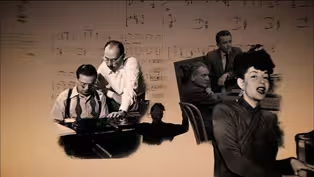
Broadway Musicals: A Jewish Legacy Preview
Preview: S40 Ep6 | 30s | An exploration of the unique role Jews had in the creation of the modern musical. (30s)
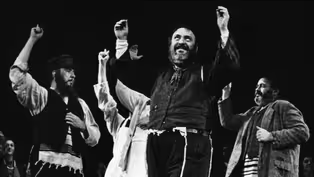
Video has Closed Captions
Clip: S40 Ep6 | 5m 10s | The surprising universality of the Jerry Bock and Sheldon Harnick musical Fiddler on Roof. (5m 10s)
Providing Support for PBS.org
Learn Moreabout PBS online sponsorship New Episode
- Arts and Music

Innovative musicians from every genre perform live in the longest-running music series.

- Arts and Music
The Best of the Joy of Painting with Bob Ross
A pop icon, Bob Ross offers soothing words of wisdom as he paints captivating landscapes.




 New Episode
 New Episode
 New Episode
Support for PBS provided by:
Major series funding for GREAT PERFORMANCES is provided by The Joseph & Robert Cornell Memorial Foundation, the Anna-Maria and Stephen Kellen Arts Fund, the LuEsther T. Mertz Charitable Trust, Sue...