
Florida Farmers Feed Florida
Clip: 4/13/2026 | 6m 24sVideo has Closed Captions
Growers down south step up efforts to help the hungry as part of “Farmers Feed Florida.”
Growers down south step up efforts to help the hungry as part of “Farmers Feed Florida.”
Problems playing video? | Closed Captioning Feedback
Problems playing video? | Closed Captioning Feedback
America's Heartland is presented by your local public television station.
Funding for America’s Heartland is provided by US Soy, Sustainable Agriculture Research and Education, Rural Development Partners, and a Specialty Crop Grant from the California Department of Food and Agriculture.
Florida Farmers Feed Florida
Clip: 4/13/2026 | 6m 24sVideo has Closed Captions
Growers down south step up efforts to help the hungry as part of “Farmers Feed Florida.”
Problems playing video? | Closed Captioning Feedback
How to Watch America's Heartland
America's Heartland is available to stream on pbs.org and the free PBS App, available on iPhone, Apple TV, Android TV, Android smartphones, Amazon Fire TV, Amazon Fire Tablet, Roku, Samsung Smart TV, and Vizio.
Providing Support for PBS.org
Learn Moreabout PBS online sponsorship>> Getting those fruits and vegetables into your diet is important in maintaining good health.
But what about those communities helping people who can't afford to buy what they need or even access fresh produce in their neighborhoods.
Well, our Jason Shoultz takes us to Florida to meet some farmers doing their part to help those less fortunate.
♪♪ >> The cucumber harvest is well underway this morning at Long and Scott Farms in central Florida.
>> But these cukes will never make it to your supermarket.
And the folks picking the produce aren't farm workers.
They're volunteers - doing what's called "gleaning" harvesting produce that's perfectly fine but not marketable.
>> So what are you looking for when you're picking these out?
>> You want to get the ones that aren't split, and these are all still pretty healthy looking, they're hiding underneath the leaves here, but you can find them in-between.
>> It's pretty amazing that the farmer isn't planning to pick this field anymore.
>> Yeah, it's just awesome that he's donating the rest of this crop to a good cause.
>> The impact of this "act of kindness" grows with every five pound bag on the pile.
And it goes beyond the field.
>> There's pickles out there on those vines.
There are a lot of good ones still left.
Chances are there's not enough to make it feasible for us to back through the field but there's still a lot of good fruit on those vines that edible and can feed a lot of folks.
>> This is the sorting shed at Long and Scott Farms where workers sort cucumbers by shape and size.
The long green produce will be shipped to markets up north or end up getting pickled.
But many of the cucumbers aren't the "right size" for pickling.
♪♪ >> Those cucumbers thousands of them end up in these big boxes.
A donation worth tens of thousands of dollars made by Hank Scott to Florida food banks.
Hank participates in the "Farmers Feeding Florida" food recovery program - connecting farmers with Florida food banks.
>> You hate to see a crop that you've worked so hard to grow to go to waste.
I mean you're growing it to feed people; you want it to feed people.
if you can get the stuff that's not marketable in the right hands where it can help people that are in need--that's the greatest thing in the world, the greatest feeling in the world.
>> So it is just huge for somebody like Hank Scott to to step up and actually donate this amount of product.
Because, you know, there's a cost to it, you know?
And there's a cost of getting it out of the field.
And there's a, you know, getting it in to our trucks.
>> It may be a concept that's hard to wrap your mind around.
Here - in Central Florida where an abundance of fresh produce is grown - many families face hunger issues.
>> We've been really hard-hit by the economy here in Florida.
As you probably know, we were sort of ground-zero for the foreclosures in the country.
Florida is ranked 8th in the nation in food hardship.
>> At the same time many of Hank's neighbors are having trouble buying food, amazingly much of the crop he grows actually could end up rotting in the field!
If the market price for his crop is too low, Hank actually loses money by hiring people to harvest!
It's a dilemma faced by farmers across the US.
>> Yeah, and it's one of those variables you got no control of and that's the market, When all the variables come together, and the stars are aligned, and everything is just right and you get good yields, and there's just too much produce around, you know, the prices will be half what they were the year before and that's tough.
>> Not only is it not worth it to us, it doesn't pay us to go harvest it, but we can't even afford to give it away, really.
It's too expensive to give away.
And that's where the food bank comes in.
They've got the avenues to move this stuff and get it to the right people, and that what's works great.
>> If we could get one percent of the surplus commodities that are grown here, that would be equivalent to about 60 million pounds of product a year.
So that's one percent of the surplus.
>> While having volunteers harvest donated crops like these cucumbers may seem like a no-brainer, it can be a tough sell for farmers concerned about legal and liability issues.
But as food banks work to meet a growing demand, they're increasingly turning to neighbors in the agricultural community.
>> Farmers are a, there's a natural hesitation.
I could totally understand it, at the onset that, "Wow, if I donate this food, what if somebody gets sick from this?"
The people that are eating this food their immune systems are already compromised, you know?
And that's a legitimate concern.
But there's a Federal law in place, the Good Samaritan Act has been around since 1996, you know?
And it's in place and it protects any food donor from legal liability.
God-forbid somebody gets sick from that food.
>> I think sometimes you can over worry about legal issues.
You know, I think when it comes to doing something like this they take care of themselves.
You know, you're doing something good, you're doing something right.
I just don't think legal issues don't even enter my mind when it comes to that stuff.
>> Not far from Hank's farm, the cucumbers are being boxed by Boy Scout volunteers at the Second Harvest food distribution center.
They'll end up at food pantries and hunger programs all across the region.
And while the team here says they appreciate pre-packaged food donations, produce like this is especially important to those facing hunger.
>> A nutritious and delicious donation... fresh from the farm.
>> Florida is the number one producer of cucumbers in the United States.
And while botanically a fruit, cucumbers are generally thought of as vegetables.
The fruits... or vegetables... originated in India where they've been raised for some three thousand years.
 New
NewVideo has Closed Captions
Farmers harvest lots and lots of lettuce from America's winter salad bowl in Arizona. (4m 44s)
 New
NewFarm to Fork Cauliflower Frittata
Video has Closed Captions
On Farm to Fork, we’ll learn how to prepare a frittata made with cauliflower. (6m 36s)
 New
NewVideo has Closed Captions
Montana farmers cash in on a growing demand for gluten free farm crops. (4m 48s)
Providing Support for PBS.org
Learn Moreabout PBS online sponsorship
- Food
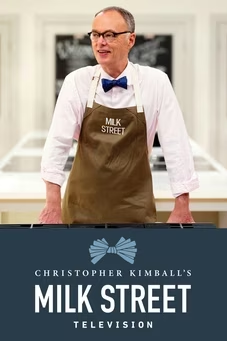
Christopher Kimball’s Milk Street Television
Transform home cooking with the editors of Christopher Kimball’s Milk Street Magazine.


Support for PBS provided by:
America's Heartland is presented by your local public television station.
Funding for America’s Heartland is provided by US Soy, Sustainable Agriculture Research and Education, Rural Development Partners, and a Specialty Crop Grant from the California Department of Food and Agriculture.